CTR and average position
The two derived metrics in every GSC report. Simple definitions, sneaky math - here's how not to get fooled.
CTR (click-through rate)
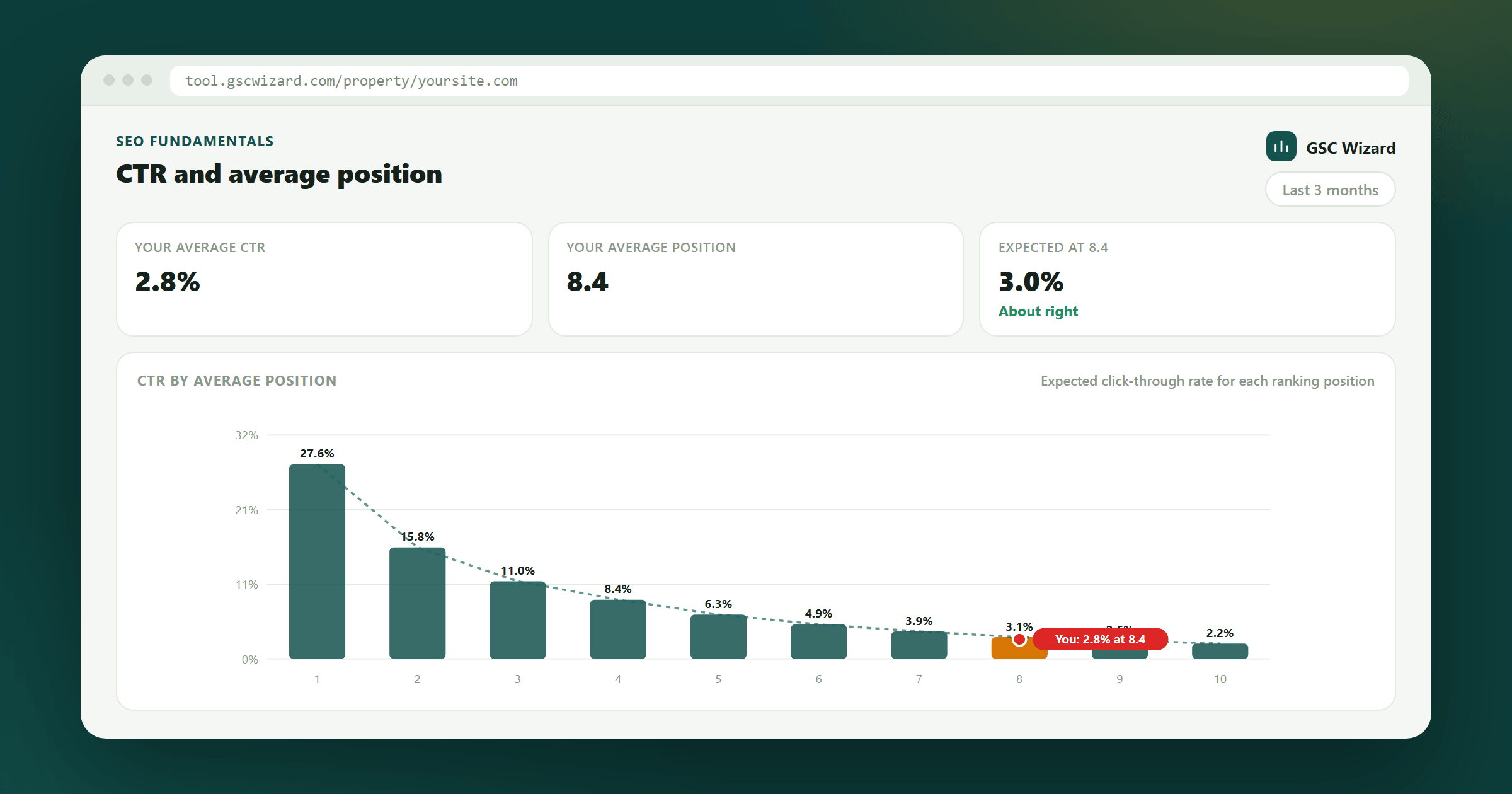
CTR = clicks ÷ impressions × 100%. It's the percentage of people who saw your listing and actually clicked it. Higher is better, up to a point - the theoretical ceiling depends on how you rank.
A "good" CTR depends entirely on position. At position 1, a generic informational query averages 25-35% CTR. At position 5 it drops to 5-7%. At position 11, it's under 1%. That's why the good CTR in GSC FAQ's answer is always "it depends on position."
Average position
GSC's average position is the average rank of your highest-ranking URL for each query, weighted by impressions. If your page ranked position 2 on 100 impressions and position 20 on 900 impressions, your reported average position is roughly 18.2, not 11.
This matters because a page averaging "position 9" might never actually show on page 1 - it flickers between position 5 for niche queries and position 15 for broad ones. Full detail: Google Search Console average position explained.
Why averages mislead
Consider a page with two queries:
- Query A: 100 impressions, position 1, CTR 30%, 30 clicks.
- Query B: 900 impressions, position 15, CTR 0.3%, 3 clicks.
The page's averaged numbers: position ~13.6, CTR 3.3%. That averaged CTR looks "fine," but it's hiding a 30% CTR on a high-intent query (excellent) and a 0.3% CTR on a low-intent long-tail (irrelevant). Break the data down by query to see what's actually happening - which is exactly what the GSC Wizard Performance view does.
"Expected" CTR by position
Every GSC account accumulates enough data to estimate an expected CTR for each position on your own site. This is valuable because industry benchmarks vary wildly by vertical. Our CTR Benchmark report computes your personal curve and flags pages scoring below it - those are the ones with meta descriptions worth rewriting.
Common pitfalls
- Panic at a position drop. Google rotates results. Expect 1-2 position of noise week over week.
- Confusing "position" with "rank" on a specific SERP. GSC reports an average; your personal live search may show something different.
- Chasing CTR on queries in position 15+. Move the ranking first, worry about CTR second.
- Comparing CTR to industry benchmarks without adjusting for position. The only meaningful benchmark is your own site.
Next up: Indexing explained - because you can't rank for a page Google doesn't index.
Written by Jan-Willem Bobbink · Published April 19, 2026 · Updated August 28, 2026