Clicks vs. impressions
Two numbers, two very different questions. Once you understand the gap between them, every "what should I optimize next?" question answers itself.
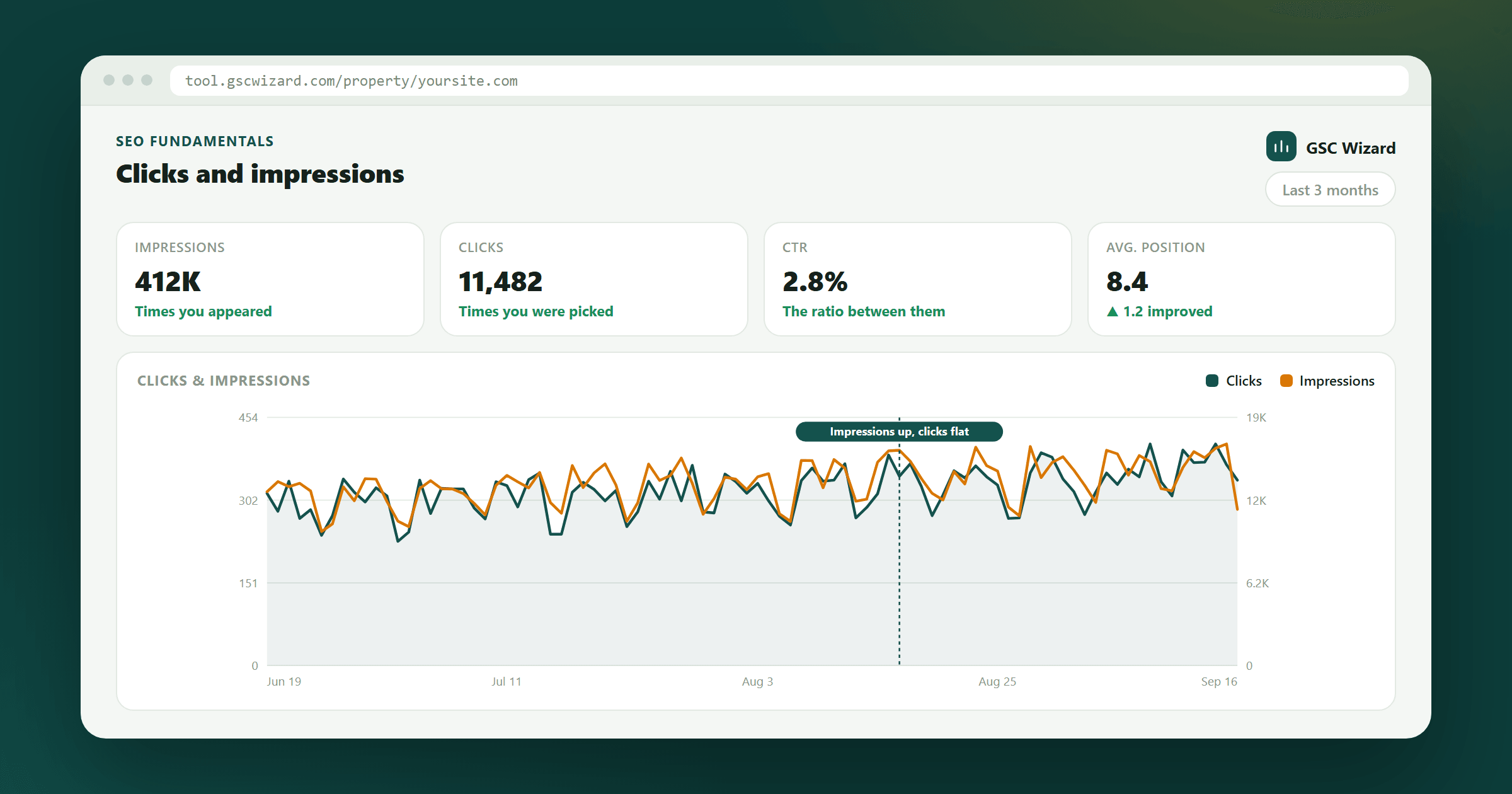
Quick definitions
One of your pages appeared in Google's search results. The user may or may not have scrolled to it, and they definitely didn't click.
The user clicked your listing in the results and landed on your site.
Impressions don't mean what you think
An impression is counted whenever your page shows up in the results - even if the user never scrolls to it. For queries where you rank in position 15, you'll accumulate impressions that will almost never produce a click, because nobody scrolls to the second page. For a detailed breakdown, see the full clicks vs. impressions FAQ and the companion difference between clicks and impressions.
The gap is where opportunities live
When you see a query or page with many impressions but few clicks, that's a signal. It usually means one of three things:
- You rank, but not high enough. (Fix with a striking distance push.)
- You rank high, but your title or meta description isn't compelling. (Fix with a CTR recovery pass.)
- The query doesn't match user intent - they're not looking for what you sell. (Accept and move on.)
High impressions with zero clicks is not a bug. It's a list of problems to triage.
A worked example
Your page /guide-to-oat-milk has 10,000 impressions, 50 clicks, CTR 0.5%, average position 11.2. What does this say?
- You're getting seen (10k impressions is plenty).
- You're on page 2 on average (position 11.2), so very few people scroll to you.
- CTR is garbage because of the position - not because the title is bad.
- Action: push the page up the ranking - not rewrite the meta. Get the ranking into top 10 and CTR will climb on its own.
Contrast: same page with 10,000 impressions, 80 clicks, CTR 0.8%, average position 3.5. Top-3 ranking with an 0.8% CTR is unusual - you'd expect 10%+. That's a meta-description problem.
How GSC counts impressions
One search = one impression per query-page pair. If your page appears for the same query twice in the same session (pagination, refresh), that's typically two impressions. Features like sitelinks sometimes count the parent URL separately from the sitelink URL. Don't over-read the exact number; focus on relative change over time.
Next up: CTR and average position - the two derived metrics that tie it all together.
Written by Jan-Willem Bobbink · Published April 19, 2026 · Updated August 28, 2026