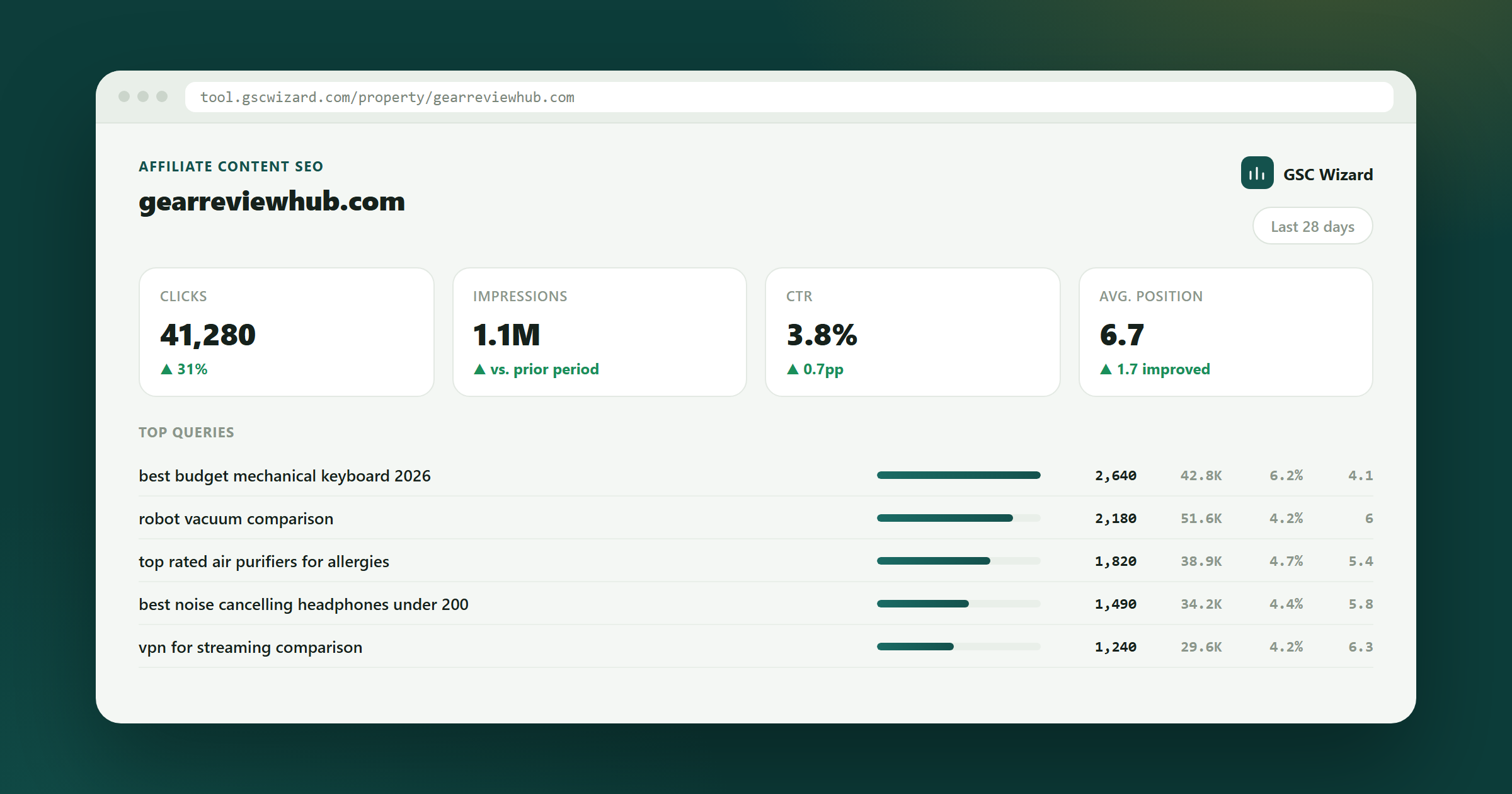
Affiliate SEO
You cannot outspend the brands you review, and you rarely outrank them. What you can do is win a bigger share of the clicks at the position you already hold. GSC Wizard benchmarks every money page against the CTR curve for its actual position and shows you what a rewrite is worth before you write it.
Includes a title-test workflow with a real before/after readout.
The lever nobody pulls
Underperforming CTR on a page you already rank for is free traffic sitting in your own account.
Ranking work is slow, expensive and competitive. A snippet rewrite ships in an hour. When a page at position 4 is getting the click-through rate of position 8, the gap is not a ranking problem - it is a headline problem, and it is measurable to the click.
It is rarely the thing the forums are shouting about that week.
Every buying guide decays as products age out and competitors publish a 2026 version. It is gradual, it never triggers an alert, and by the time the page falls out of the top five it needs a full rewrite rather than a refresh. Caught at the first slip, it needs an afternoon.
Affiliate sites tend to have one section that carries the money and another that carries the volume. Sitewide traffic can look fine while every commercial page loses two positions - which is the only part that pays.
Titles get rewritten in batches, rankings move for unrelated reasons, and nobody ever proves anything. Without a before-and-after window on the specific URLs you changed, title work is superstition with extra steps.
The CTR work first - it pays fastest - then decay defence, then proof.
The CTR benchmark models the expected click-through rate for each position on your own property, then flags the pages performing under their own curve. That list is your rewrite queue, sorted by clicks available.
Content groups for /best/, /review/, /vs/ and /guides/ mean you can see the money section move on its own. Query shape analysis adds the other half - commercial versus informational intent inside the queries themselves.
Decay tracking flags a guide the week it starts sliding from position 3 to 5, not the month it lands on page two. On affiliate content that is the difference between a refresh and a rebuild.
The experimentation report takes a set of URLs and a change date and gives you the before/after readout against the rest of the site as a control, so a title test produces evidence instead of an opinion.
Ranked by clicks you are leaving behind, not by traffic you already have.
CTR OPPORTUNITIES - commercial pages, last 28 days

URL                          pos   CTR    expected   clicks left
/best-robot-vacuums/         3.4   2.1%     6.8%        +1,940
/best-espresso-machines/     4.1   1.9%     5.4%        +1,120
/dyson-v15-review/           2.8   4.4%     8.1%          +980
/sonos-vs-bose/              5.2   1.4%     4.0%          +610

TITLE PATTERNS THAT UNDERPERFORM ON THIS SITE
  Titles over 62 characters      avg CTR gap  -2.4pt
  Titles without a year          avg CTR gap  -1.9pt

DECAY WATCH - commercial section only
  /best-standing-desks/   pos 2.6 -> 4.3 over 6 weeks. Refresh now.

LAST TEST: 12 titles rewritten on 04 Aug
  Test group +18.3% clicks. Control group +1.1%. Keep the change.
The last block is the one that changes how you work: a rewrite either beats the control or it does not, and you find out in two weeks.
CTR gap versus your own curve
Not against an industry benchmark - against the curve your property actually produces. Every point of gap on a ranking page is traffic you already earned and are not collecting.
Commercial section position
Average position across /best/, /review/ and /vs/ only. This is the number that tracks revenue; sitewide position does not.
Time-to-first-slip on guides
How many weeks pass between a guide peaking and losing its first position. It sets your refresh cadence better than any content calendar.
Test lift versus control
Every batch of title or intro rewrites measured against the untouched rest of the site. It is the only way to know whether your CTR work is working.
It is usually the highest return per hour available to an affiliate site. Moving a page from position 4 to 3 is weeks of work and might not happen; closing a two-point CTR gap on that same page is a title and meta rewrite, and the benchmark tells you in advance roughly what it is worth in clicks.
Group the commercial URLs separately, then read the section chart rather than the sitewide one. Change-point detection dates any statistical break in that section, and the algorithm update list shows what shipped around then.
Yes, on a group of pages. Mark the URLs you changed and the date, and the experimentation report compares their performance to the rest of the site over the same window, so seasonality and updates hit both groups. It is a before-and-after with a control, which is what SEO testing realistically allows.
Yes. Add each site as its own property and the cross-site summary puts them side by side, so you can see which of your sites moved without opening five dashboards. Plans include multiple properties.
Written by Jan-Willem Bobbink · Published August 26, 2026
Creator SEO
One hour a week, three posts refreshed. That beats publishing more, and it is the whole routine.
iGaming SEO
One market can collapse while the total looks fine. Per-country reporting is not optional in regulated verticals.
Ecommerce SEO
Category pages earn the money, product pages get the reporting. Split them and the picture changes.
Connect Search Console and get your CTR opportunity list, sorted by clicks available, in a few minutes.
Practical GSC and GA4 workflows, product updates and SEO experiments. No spam, unsubscribe anytime.