Query Analysis
Which of your queries are people typing, and which are fragments of a conversation with an AI?
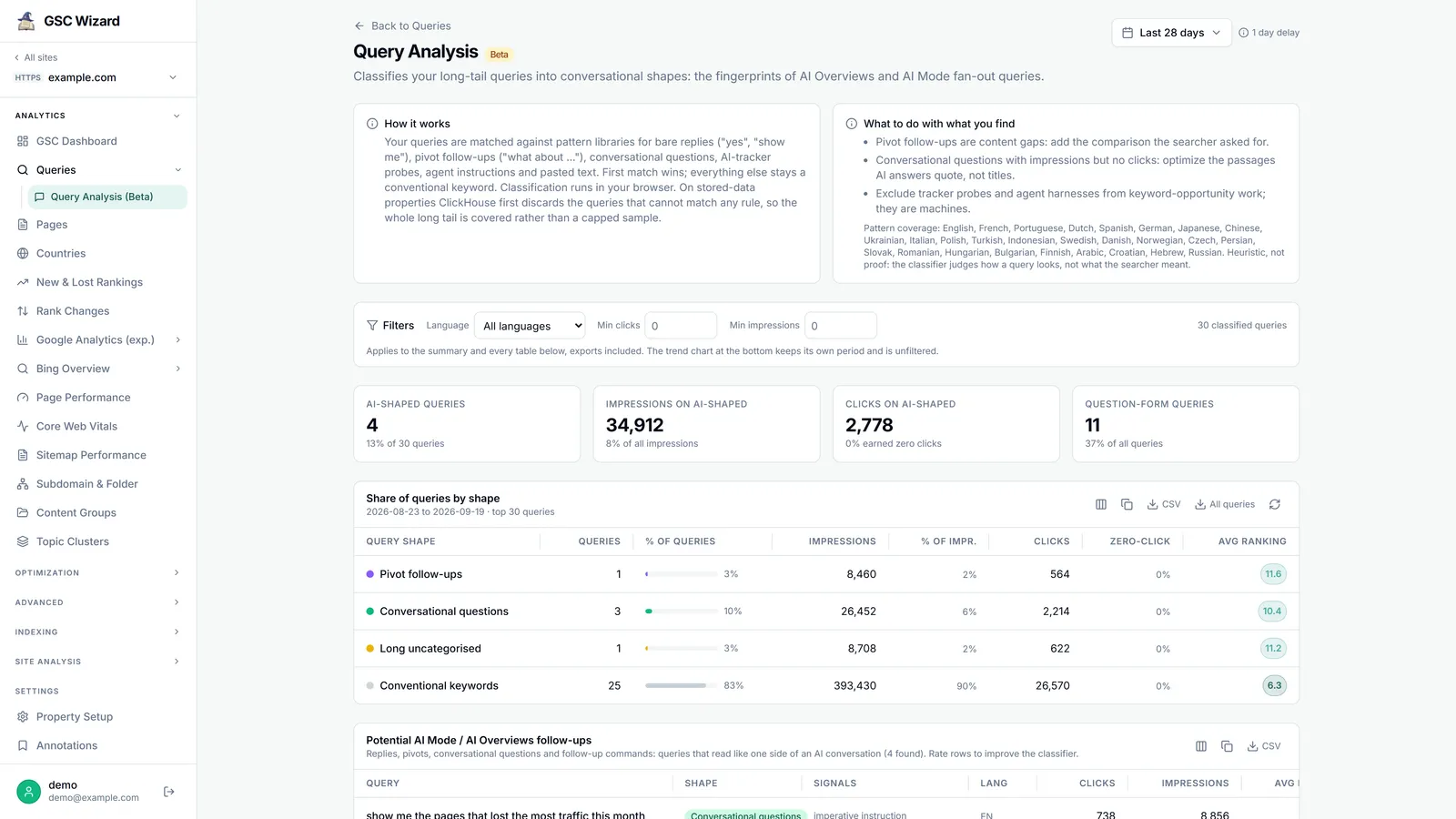
Assistants send pieces of conversations to Google. A reply like “yes”, a follow-up like “what about gemini”, a question phrased at a listener rather than a search box: these land in Search Console looking nothing like a typed keyword, and they are the visible fingerprint of AI Overviews and AI Mode fan-out. Query Analysis groups your queries by shape instead of by topic, so that traffic stops hiding inside your long tail.
The eight query shapes
Each query matches the first shape it fits; anything with no conversational or machine markers stays a conventional keyword.
- Reply artefacts – bare mid-conversation replies (“yes”, “sure”, “show me”, “try again”). Someone answered an AI and the reply was processed as a search.
- Pivot follow-ups – mid-conversation comparisons (“what about gemini”, “how about in chinese?”). The searcher is asking the AI to test an alternative.
- Conversational questions – phrased at a listener (“can you jailbreak meta raybans”, “is it free”, “i am using lmstudio…”).
- LLM tracker probes – synthetic prompts from AI visibility tools, usually carrying a location or language suffix.
- Agent harnesses – a whole machine instruction logged as one query (“search the web for… do not invent results”).
- Pasted strings – error messages, spreadsheet headers, and other copy-pasted text searched as-is.
- Long uncategorised – 10+ words with no clearer marker; held back for you to read rather than guessed at.
- Conventional keywords – ordinary search demand.
What you get
- Summary cards: AI-shaped queries, their impressions and clicks, the share that earned zero clicks, and how many queries are question-form.
- A share-of-shapes table with each bucket’s queries, impressions, clicks, zero-click rate, and average ranking.
- A Potential AI Mode / AI Overviews follow-ups table combining the three conversational shapes, with the signals that matched and the top landing page per query.
- Collapsible per-shape tables, and CSV export of the full classification or of the AI-shaped queries alone.
Trend over time
The bottom of the report answers the question a single period cannot: is this growing?
Pick 3, 6, 12, or 16 months (12 by default) and the chart stacks monthly clicks or impressions into AI-shaped versus conventional, with the AI-shaped share drawn as a line. The current month is marked as partial, since it is still filling up. It loads behind its own button because it fetches a month of query data per bar.
Rating the classifier
Every row can be corrected, and the corrections are the point.
- Thumbs up confirms a classification; thumbs down opens a “this query is actually…” menu with the other shapes.
- The Flag a missed query box catches AI-shaped queries the report filed as conventional.
- Feedback is stored per property and used to train a future model, so a correction improves the report for everyone rather than only hiding a row.
How to run it
- Open Queries → Query Analysis in the sidebar, or use the Query analysis button in the Queries report header.
- Choose a period and press Run Analysis. Nothing fetches until you do.
- Classification runs in your browser over the period’s top queries, in English plus 26 other languages (French, Portuguese, Dutch, Spanish, German, Japanese, Chinese, Ukrainian, Italian, Polish, Turkish, Indonesian, Swedish, Danish, Norwegian, Czech, Persian, Slovak, Romanian, Hungarian, Bulgarian, Finnish, Arabic, Croatian, Hebrew, Russian).
Read it as evidence, not proof. The classifier judges how a query looks, not what the searcher meant, so a deliberately typed short query can land in a conversational bucket. Search Console also anonymises many low-volume queries, so what you see is the visible tip of the conversational traffic, not its full volume. Treat tracker probes and agent harnesses as machine traffic and keep them out of keyword-opportunity work.
Same analysis from an AI assistant: the MCP server exposes analyze_query_shapes for the per-shape breakdown and get_query_shape_trend for the monthly trend. The bucket taxonomy follows Suganthan Mohanadasan’s research on AI Mode queries in Search Console.
Part of Queries, Pages & Countries. Related: Queries, Pages, Countries.