Multi-location SEO
A franchise site is not 200 pages, it is one template rendered 200 times. That is the risk and the opportunity: a bad heading structure is duplicated 200 times, and a good fix ships 200 times too. GSC Wizard lets you test the template on a subset, measure it against the rest, and roll out with evidence.
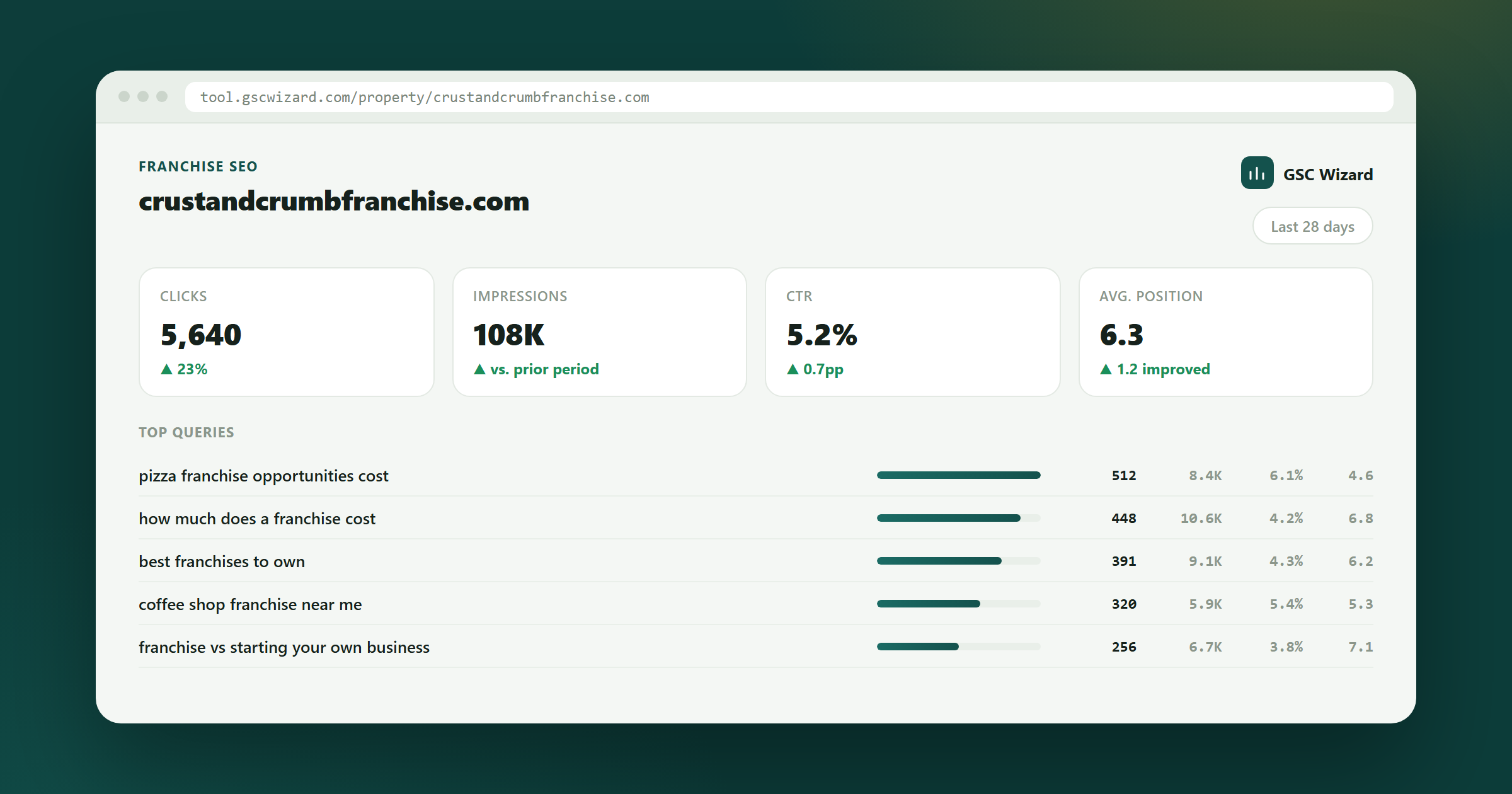
Location grouping, template experiments and per-franchisee report links.
Leverage cuts both ways
The most valuable SEO test you can run is on ten location pages, not on one.
Nothing else in SEO gives you a clean control group for free. Change the template on a sample of locations, leave the rest untouched, and you have a real experiment - same site, same updates, same seasonality. Then roll out the winner across every location at once.
The problems scale exactly as fast as the location count.
Three branches within twenty miles all target the same metro term. Google picks one, rotates, or ranks none of them well. The franchisees each think their page is broken; the real issue is that the pages are indistinguishable to a search engine.
The template gets updated, all 200 pages change on the same day, and traffic moves for a dozen unrelated reasons. Without a held-back control group the rollout can never be evaluated, so template decisions are made on taste forever.
Every location owner asks how their page is doing. Sending a monthly spreadsheet is a job; giving each of them access to head-office Search Console is not an option. So they get nothing, and they assume nothing is happening.
Cluster the locations, test the template, then let the franchisees self-serve.
URL clustering groups the near-identical location URLs so you can compare hundreds of pages as one cohort and immediately see the spread between the best and worst performing branches.
Apply the change to a sample of locations, mark the date, and the experimentation report measures that group against the untouched locations. Same seasonality, same algorithm updates, real control.
Cannibalization analysis exposes which branches are fighting over the same metro query, so you can differentiate the pages that are worth keeping and consolidate the ones that are not.
Shared report links show a filtered view of the data with no account access. Each location owner gets their own page's numbers, updated automatically, and head office stops running a spreadsheet service.
What a proper multi-location test looks like when it finishes.
FRANCHISE TEMPLATE TEST - location pages, 6 weeks

TEST GROUP     20 locations   new template (FAQ + hours schema + reviews)
CONTROL       180 locations   unchanged

               clicks   impressions   avg pos    CTR
  Test         +23.4%       +4.1%      -0.6      +2.9pt
  Control       +2.2%       +3.7%      -0.1      +0.1pt
  -> lift is in CTR and position, not in demand. Roll it out.

LOCATION SPREAD - 200 pages
  Top decile     avg pos 3.1
  Median         avg pos 7.4
  Bottom decile  avg pos 18.9   <- 20 branches effectively invisible

OVERLAPPING METROS
  3 branches competing on 'service [metro]'. Differentiate or
  designate one metro page and link the others to it.

FRANCHISEE LINKS  200 live report links, refreshed daily
The spread between the top and bottom decile is usually the biggest finding: same template, same brand, wildly different outcomes, and now you can see which branches to look at.
Location page spread
The distribution of position across all locations, not the average. The average hides that twenty of your branches never appear in search at all.
Template test lift
Test-group performance minus control-group performance. The only honest way to evaluate a change that lands on every page at once.
Metro overlap count
How many of your locations are competing with each other for the same query. It is usually higher than head office expects.
Coverage rate
Share of location pages that rank in the top ten for their own city plus service term. The core health metric for a multi-location estate.
Change a sample and hold the rest back as a control. Mark the URLs and the change date, and the experimentation report compares the two groups over the same period - so seasonality and core updates affect both sides equally and the difference is attributable to the template.
Yes, through shared report links. Each one is a filtered, read-only view that updates automatically and requires no access to your Search Console account. It replaces the monthly spreadsheet that head office is usually stuck producing.
Cannibalization analysis first, to confirm they are genuinely competing for the same query rather than just being near each other. Where they are, the usual fix is to differentiate the content meaningfully or to designate one page as the metro-level target and have the other link to it.
Yes. Each domain is a property, the cross-site summary compares them, and team seats let regional managers see only their own. The internationalization report covers hreflang and cross-market issues on top of that.
Written by Jan-Willem Bobbink · Published August 28, 2026
Local services SEO
Your traffic doubled because it got cold, not because SEO worked. Separate demand from performance.
Hotel SEO
Your own hotel name is your most valuable keyword, and an OTA is probably outranking you for it.
Enterprise SEO
Replatforming is the biggest risk on your roadmap. Measure the migration URL by URL, not by a traffic graph.
Cluster your location pages, prove the template change, and give every franchisee their own link.
Practical GSC and GA4 workflows, product updates and SEO experiments. No spam, unsubscribe anytime.