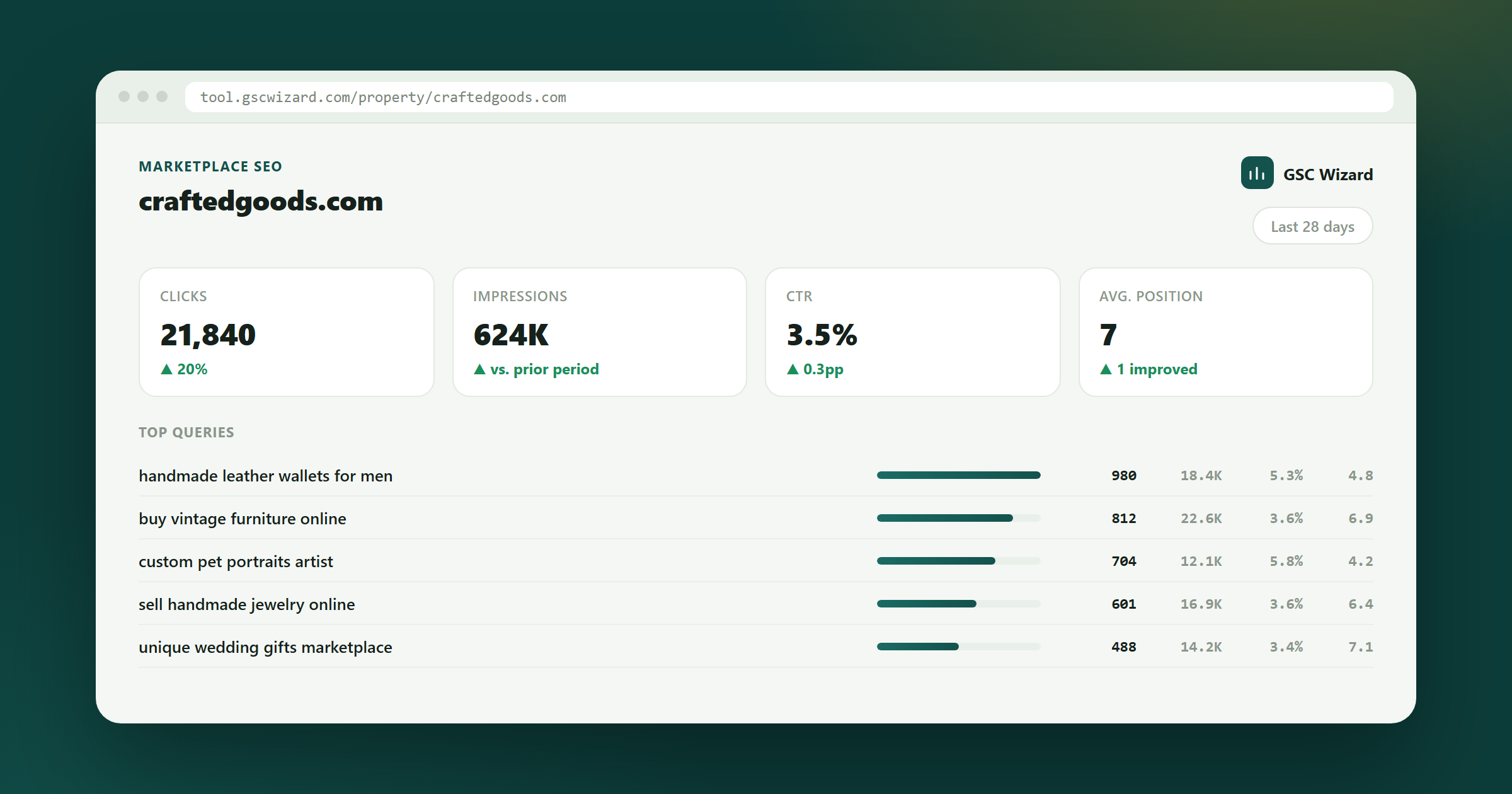
Marketplace SEO
Marketplace SEO is not a content problem, it is an allocation problem. Every faceted combination you generate competes with every other one for a crawl budget you do not control. GSC Wizard clusters those millions of URLs into patterns you can actually reason about, and shows which patterns earn their place in the index.
Pattern-level analysis across large URL sets, not a top-1,000 export.
The allocation problem
Every worthless facet you let Google crawl is a listing page it did not crawl instead.
At marketplace scale you cannot get everything indexed and you should not want to. The job is deciding which URL patterns deserve crawl budget and closing off the rest. That decision needs pattern-level data, and pattern-level data is exactly what the Search Console UI cannot give you.
Scale turns ordinary SEO issues into structural ones.
Category times brand times size times colour times sort order is a combinatorial explosion. Most of those pages have no search demand at all, but Google will happily spend months crawling them while your genuinely valuable category-plus-attribute pages wait.
A top pages list is meaningless on a marketplace. The only actionable unit is the pattern: /c/{category}/{brand}/ as a class, not one instance of it. Almost no reporting tool gives you performance rolled up by URL pattern.
Seller profiles, listing pages and buyer-intent category pages serve completely different business goals. Reporting them together means you never learn that your seller pages are consuming a third of your crawl budget and producing nothing.
Get to pattern level, then make allocation decisions with evidence.
URL clustering groups structurally similar URLs so you can read performance by pattern class rather than by individual page. This is the step that makes marketplace analysis possible at all.
Subdomain and folder breakdowns roll performance up your URL hierarchy, so you can see which branches of the tree earn their crawl budget and which are pure overhead.
Site analysis exposes indexed URLs with no impressions across your window. Rolled up by pattern, that becomes a robots and canonical strategy instead of an endless list of individual pages.
Full storage properties keep your Search Console history in a warehouse built for this volume, so pattern rollups run across everything rather than the top rows Google's UI will hand you.
Pattern by pattern, with a verdict on each.
MARKETPLACE PATTERN REPORT - last 90 days

PATTERN                      URLs     indexed   clicks    verdict
  /c/{cat}/                  1,240      1,190   940,200   protect
  /c/{cat}/{brand}/         28,400     19,880   410,600   protect
  /c/{cat}/{brand}/{size}/ 214,000     41,200    38,900   trim tail
  /c/{cat}/?sort=            9,800      6,410       120   block
  /c/{cat}/?page=          188,000     22,900       310   paginate
  /seller/{id}/            410,000     96,400     4,880   noindex
  /listing/{id}/         2,940,000    212,000   688,400   protect

ALLOCATION FINDING
  Facet and sort patterns hold 24% of indexed URLs and produce
  0.4% of clicks. Closing them frees crawl for /listing/.

DEMAND CHECK before blocking
  {size} facets with real query demand: 1,880 of 214,000.
  Keep those as static category pages, block the rest.
The last block matters - blocking a facet pattern wholesale destroys the small number of facet pages that genuinely have demand. Check first, then block.
Clicks per indexed URL, by pattern
The efficiency measure that decides allocation. A pattern with 200,000 indexed URLs and 300 clicks is not an opportunity, it is a tax.
Index coverage of the money pattern
What share of your listing or category pages are indexed at all. This is the number that facet bloat is silently suppressing.
Facet demand hit rate
How many of your generated facet combinations have any real search demand. Usually under 1%, and knowing the number changes the architecture debate.
Supply versus demand click split
Seller and profile pages against buyer-intent pages. Both matter to the business, but only one of them should be consuming crawl budget at scale.
That is what the pattern-level tooling is for. Full storage properties keep historical performance in a column store designed for this volume, and URL clustering rolls individual URLs into pattern classes so the analysis is readable rather than a list of two million rows.
Cluster the facet URLs, look at clicks and impressions per pattern, and check which specific combinations have genuine query demand before blocking a pattern wholesale. The usual outcome is a small allowlist of demand-backed facets promoted to real category pages, with the rest closed off.
It applies to Google's own UI and export. GSC Wizard pulls through the API and stores the history, so reports run over the full data set rather than the top rows - which on a marketplace is the difference between a usable analysis and a decorative one.
Yes, with content groups or URL clustering by pattern. Keeping supply-side and demand-side pages in separate reports is usually the first thing that changes how a marketplace team prioritises technical work.
Written by Jan-Willem Bobbink · Published August 29, 2026
Ecommerce SEO
Category pages earn the money, product pages get the reporting. Split them and the picture changes.
Job board SEO
Expired jobs still in the index are worse than no page at all. And your category grid, not your postings, is the asset.
Enterprise SEO
Replatforming is the biggest risk on your roadmap. Measure the migration URL by URL, not by a traffic graph.
Cluster your URL patterns, find the bloat, and get your listing pages indexed.
Practical GSC and GA4 workflows, product updates and SEO experiments. No spam, unsubscribe anytime.