Agency SEO
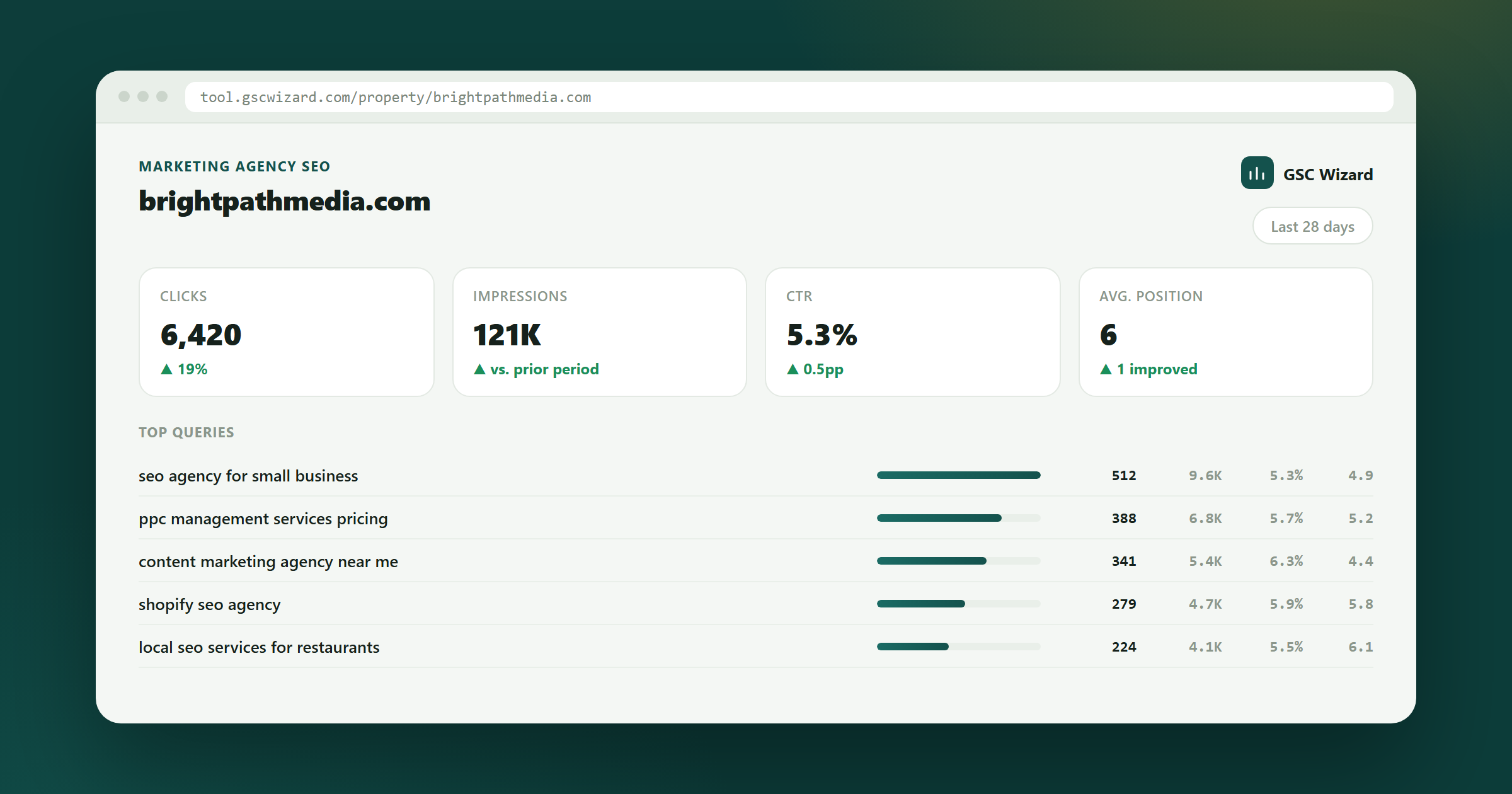
Agencies do not lose clients because rankings dropped. They lose them in the week they could not explain why. GSC Wizard puts every client property on one screen, turns the monthly deck into a live link, and keeps a dated record of every change you shipped so the answer is always ready.
Multi-property accounts, team seats and client-facing report links.
Where the margin goes
Three days a month per client, spent rebuilding a deck nobody reads past slide four.
Reporting is the single biggest non-billable cost in a retainer. It is also the deliverable clients judge you on. Automating the assembly does not make the report worse - it frees the hours that used to go into copy-paste for the analysis clients are actually paying for.
Every agency over five clients has all of them.
With fifteen properties, nobody is looking at all of them every week. A core update hits four accounts on a Thursday and you hear about it on Monday from the one client who checks their own Search Console. That call sets the tone for the whole quarter.
The renewal conversation is about the last two years. Google keeps sixteen months. So the chart that proves what you achieved in year one has expired precisely when you need it to justify year three.
A client asks why traffic fell in March. Somewhere there is a Slack message about a migration, a note about a title rollout and a redesign that shipped that month. Reconstructing the timeline takes half a day and the answer is still a guess.
Once per agency, then once per client onboarding.
The cross-site summary shows all connected properties with their movement side by side, so the Monday check is one screen instead of fifteen logins. Anomalies surface where you can see them.
Shared report links give clients a read-only, always-current view of their own data with no access to your account or your other clients. The monthly deck becomes a summary of decisions, not a data-entry exercise.
Annotations put dated markers on the charts - migrations, title rollouts, redesigns, algorithm updates. When a client asks about March, the answer is on the chart instead of in someone's memory.
Full storage properties retain up to 10 years of Search Console data, so the year-one baseline is still there at renewal - long after Google has dropped it.
Every account, one page, before the first client call.
AGENCY PORTFOLIO - week 34

CLIENT              clicks    vs 4wk   flag
  Client A         184,300      -2%
  Client B          92,140     -21%    CHANGE POINT 11 Aug
  Client C          44,880      +6%
  Client D          38,220      -4%
  Client E          21,010     -33%    CHANGE POINT 09 Aug
  ... 10 more within normal variance

BOTH FLAGGED ACCOUNTS: breaks fall in the same 3-day window
  -> likely algorithm update, not client-specific. Check the
     update list, then brief both clients before they call you.

CLIENT B DETAIL
  /guides/ -34%, /products/ -3%. Editorial section only.
  Last annotation: 'template change on guides' - 02 Aug.
  -> Overlaps the break. Roll back and measure.

CLIENT REPORT LINKS  15 live, refreshed daily, 0 decks to build
Two flagged accounts on the same date is the finding. One client-specific drop is a problem; two on the same day is an industry event you can get ahead of.
Portfolio-wide anomaly count
How many client properties broke in the same window. Correlated drops mean an update; isolated ones mean something you or the client did.
Non-branded performance per client
The metric that isolates your work from the client's own marketing. It is also the one that survives scrutiny in a renewal meeting.
Time from event to explanation
How long it takes to answer 'what happened'. With annotations and change-point dates on the chart, this drops from days to minutes - and it is what clients actually judge.
Hours spent assembling reports
Worth measuring once. It is usually the largest recoverable cost in the entire retainer.
Yes. Shared report links are read-only views scoped to one property, with no login into your account and no visibility of your other clients. They update automatically, so the link you send in January is still current in June.
Plans include a mix of API properties for broad monitoring and full storage properties for deep history on the accounts that matter, with team seats on the higher tiers. The split exists because storing ten years of data on every property you merely monitor is unnecessarily expensive.
Shared reports are client-facing views you send directly rather than internal dashboards. If your agency needs specific branding arrangements, that is worth raising through feedback - custom plans exist and this is a common agency request.
Yes. The GSC Wizard MCP connects the same data to ChatGPT, Claude and other MCP clients, so you can ask questions across a client property in natural language and have the assistant draft the analysis section of the report from real data.
Written by Jan-Willem Bobbink · Published August 29, 2026
Enterprise SEO
Replatforming is the biggest risk on your roadmap. Measure the migration URL by URL, not by a traffic graph.
SaaS SEO
Blog traffic that never converts is not a win. Report by funnel stage or you will optimise the wrong end.
Ecommerce SEO
Category pages earn the money, product pages get the reporting. Split them and the picture changes.
Connect every client property, replace the deck with a live link, and never be surprised by a client's drop again.
Practical GSC and GA4 workflows, product updates and SEO experiments. No spam, unsubscribe anytime.