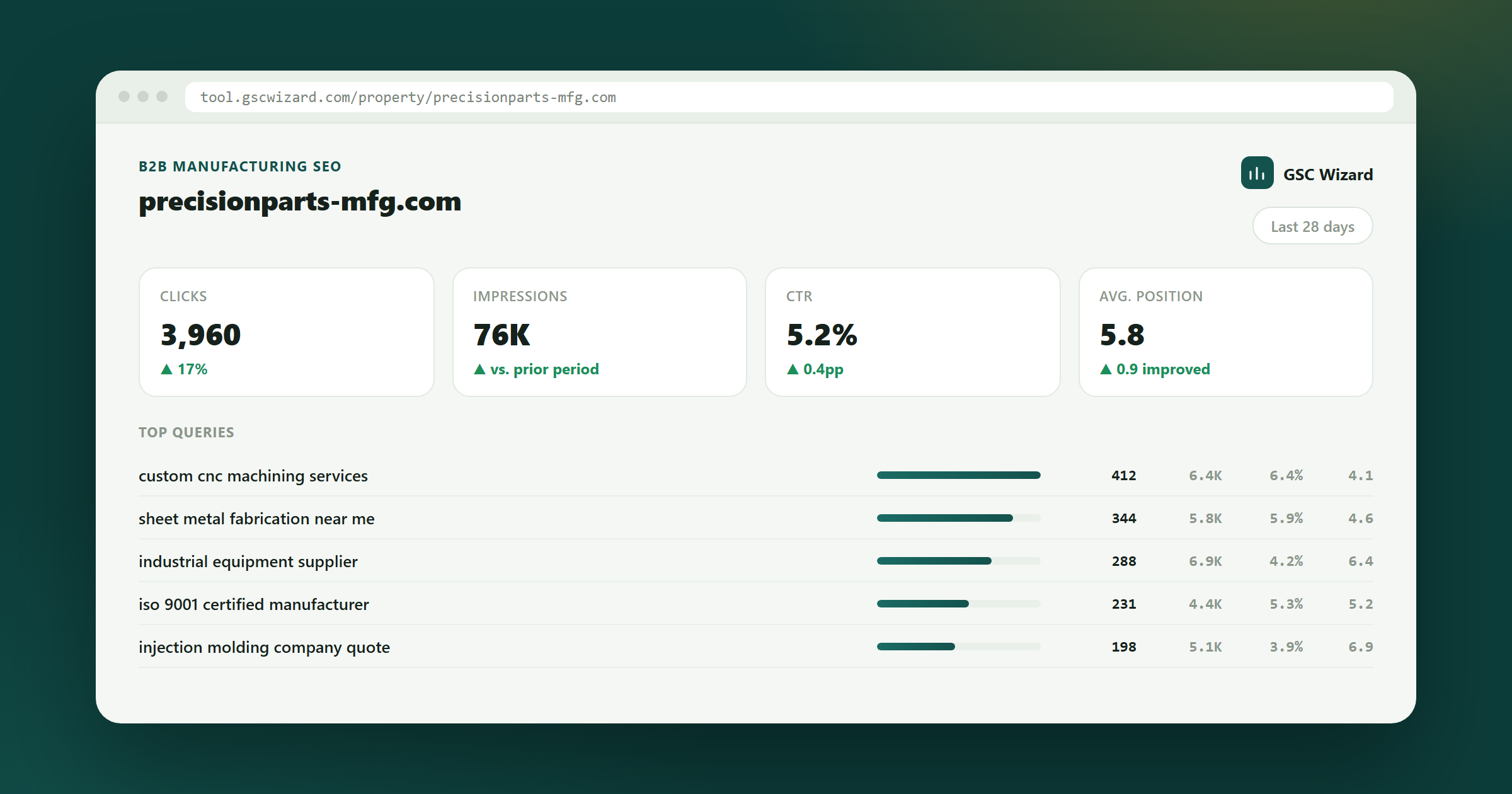
Industrial SEO
Industrial search happens in tiny numbers. A specification query with twelve impressions a month can be a specifying engineer about to write your part into a build. GSC Wizard is set up to find those queries instead of burying them under whatever your homepage ranks for.
Long-tail discovery, part-number tracking and reporting at low volumes.
The wrong unit
Your most valuable search term this year probably had under 100 impressions.
In industrial B2B the buying committee is tiny and highly specific. They search part numbers, standards, tolerances and material specifications. Those queries never make a top-terms list, so the SEO report is dominated by generic traffic while the queries that precede a purchase order go unnoticed.
Low volume is not low value, but every default report treats it that way.
Sort by clicks and you get company name, a generic category term and a blog post. The specification and part-number queries that a specifying engineer actually types sit in a long tail thousands of rows deep, where no default report ever looks.
The engineer researches in March and the purchase order lands in November. No monthly report will ever connect them, so search gets treated as a cost centre because the attribution never closes.
Your own part numbers are ranked for by three distributors and a marketplace listing before your own product page appears. It is not visible in a clicks report because you were never getting those clicks in the first place.
Change the unit of analysis from clicks to query discovery.
Long-tail clustering groups the thousands of low-volume queries into themes, which is the only way specification and application queries become visible as a pattern rather than as noise.
On a page ranking at position 30, impressions are your only evidence that demand exists at all. Position and impression reporting on product and specification pages tells you what to build before it can produce a single click.
Content groups per product family, application and industry served turn a flat site into segments that map to how the sales team is organised - and to how the report gets read.
Put product and part pages under indexing monitoring so you know they are indexed and ranking for their own identifiers - the queries where losing to a distributor is pure margin loss.
Sorted by evidence of intent, not by traffic volume.
INDUSTRIAL SEARCH REPORT - quarter to date

HIGH-INTENT QUERY THEMES (long-tail clusters)
  Theme                        queries  impressions  avg pos
  Material spec + tolerance        184        2,940     14.2
  Part number lookups              310        1,880      8.1
  Application: food-grade           96        1,120     19.4   gap
  Certification / standards        142        2,010     11.7

PART NUMBER DEFENCE - our own identifiers
  Ranking #1 by us                 188 of 310
  Distributor outranks us           94 of 310   <- margin loss
  Not ranking at all                28 of 310

DEMAND WITHOUT SUPPLY
  'food-grade' application terms show 1,120 impressions/quarter
  and we have no application page. Highest-value gap on the site.

TOTAL CLICKS  4,880   (do not lead the report with this number)
Ninety-four part numbers where a distributor outranks the manufacturer is a concrete, costed finding. Total clicks at the bottom is deliberate.
Part-number win rate
How often your own page ranks first for your own identifiers, rather than a distributor. Every loss here is a margin transfer you can measure.
High-intent impressions
Impressions on specification, tolerance and certification queries. It is a demand signal that exists long before any click does.
Application coverage gaps
Query themes with impressions but no dedicated page. On industrial sites these gaps are usually the single highest-value content decision available.
Query discovery rate
New distinct queries appearing per quarter. In a market this specific, discovering the language buyers use is worth more than another few hundred clicks.
Volume is the wrong measure when one order is worth six figures. The value is in discovery - finding the specification and application queries buyers actually use, and confirming you rank for your own part numbers. Both are visible in Search Console data and neither depends on high volume.
Long-tail clustering groups thousands of low-volume queries into themes so patterns emerge from data that is individually too sparse to read. That is how a cluster of 96 food-grade application queries becomes visible as a content decision.
You can measure your own side of it directly: which part-number queries you rank first for, which you rank poorly for, and which you do not appear for at all. That list is normally enough to prioritise product page work without any third-party rank tracker.
Not directly, and no tool honestly can across a nine-month sales cycle. What you can do is track the leading indicators - high-intent impressions, part-number win rate, form completions in GA4 - and accept them as the measurable part of a long cycle.
Written by Jan-Willem Bobbink · Published August 30, 2026
SaaS SEO
Blog traffic that never converts is not a win. Report by funnel stage or you will optimise the wrong end.
Legal SEO
One case can be worth more than a year of blog traffic. Rank your backlog by case value, not by clicks.
Enterprise SEO
Replatforming is the biggest risk on your roadmap. Measure the migration URL by URL, not by a traffic graph.
Cluster the long tail, defend your part numbers, and stop reporting on clicks.
Practical GSC and GA4 workflows, product updates and SEO experiments. No spam, unsubscribe anytime.