AI search statistics for 2026
AI search numbers travel fast and get rounded up on the way. I checked 85 of them against the original study, kept the source's own scope, and noted for each section what your own Search Console, Bing and GA4 data can and cannot show.
Last updated · Every number checked against its original source on that date
Most AI search statistics come from companies that sell AI visibility tracking, and the summary pages built on them tend to drop the fine print: which prompts were tracked, which engine, which market, which month. When I went back to the studies, a number of popular claims turned out to describe something narrower than the headline. Those are listed at the bottom with the reason.
GSC Wizard reads your own Search Console, Bing Webmaster Tools and GA4 data, so I added a note per section on what you can check yourself. That part matters more than any panel average: AI Overviews show up on 18% of searches in one study and 87% in another, and only your own data tells you which world your site lives in.
Key takeaways
- According to OpenAI (September 2026), ChatGPT has more than 1.2 billion weekly users.
- According to Google (May 2026), AI Overviews has more than 2.5 billion monthly users and AI Mode more than 1 billion.
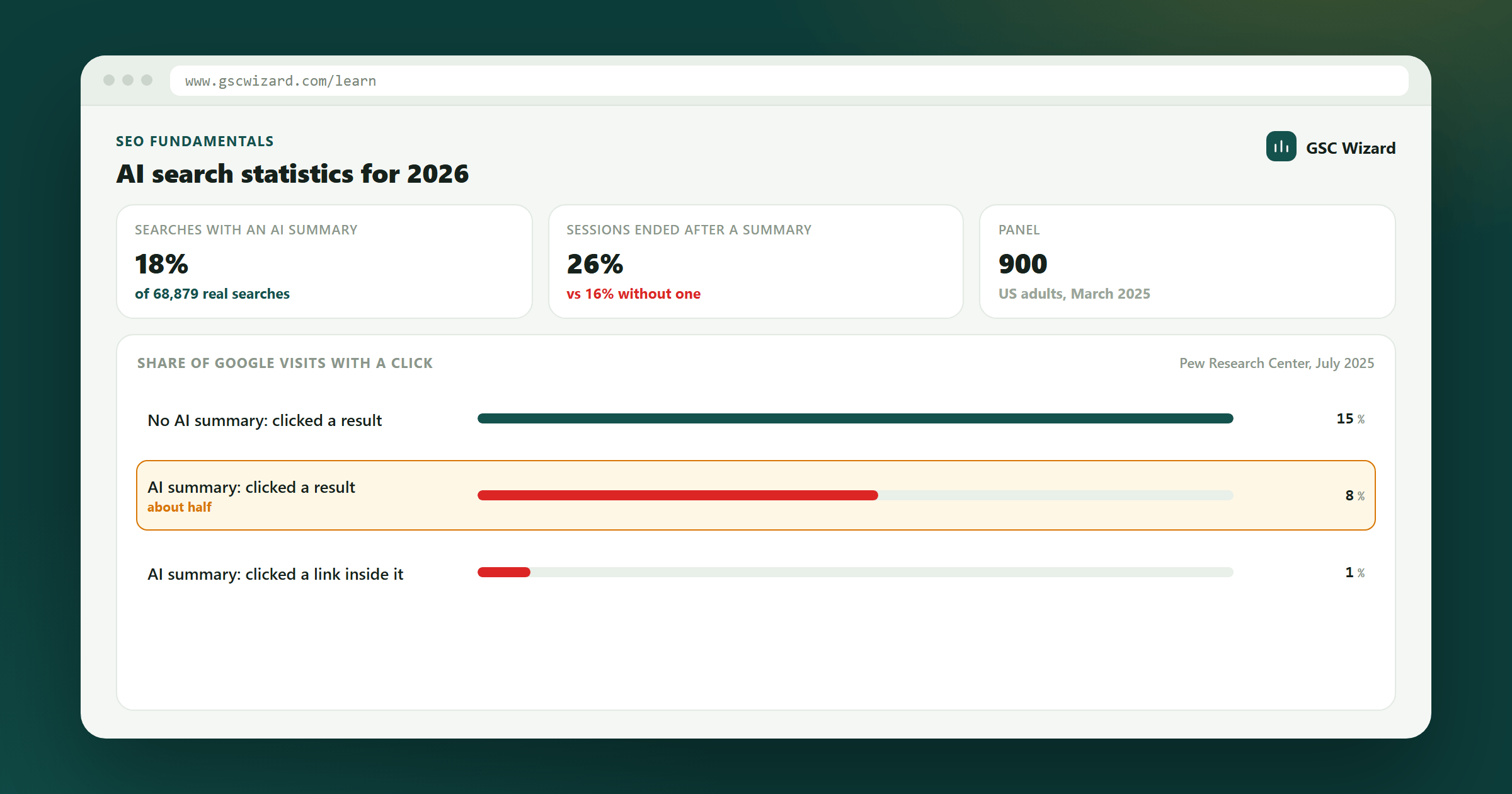
- According to Pew Research Center (July 2025), Google users clicked a search result in 8% of visits with an AI summary, against 15% without one.
- According to SE Ranking (June 2026), AI platforms sent 0.32% of all website traffic in January to April 2026.
- According to Adobe (June 2026), AI-referred visitors to US retail sites converted 54% better than other visitors in May 2026.
- According to Google (August 2026), Search Console's Generative AI performance reports are now available to every website.
AI search usage statistics
- According to OpenAI (September 2026), ChatGPT has more than 1.2 billion weekly users, up from more than 900 million in February 2026 and 800 million in October 2025.
- According to OpenAI (February 2026), ChatGPT had more than 50 million consumer subscribers.
- According to OpenAI, Duke and Harvard researchers (September 2025), ChatGPT users sent more than 2.5 billion messages a day in July 2025, and daily consumer messages grew from 451 million in June 2024 to about 2.6 billion in June 2025.
- According to the same paper, "seeking information" grew from 14% of ChatGPT messages in July 2024 to 24% a year later, the closest thing to classic search in its categories.
- According to the same paper, 49% of ChatGPT messages are "asking", 40% "doing" and 11% "expressing".
- According to Google (May 2026), AI Overviews has more than 2.5 billion monthly active users and AI Mode passed 1 billion monthly active users within a year of launch.
- According to Alphabet (July 2025), AI Overviews were "driving over 10% more queries globally" for the types of queries that show them.
- According to Similarweb (July 2026), monthly visits to generative AI platforms grew 70% year over year to 9.5 billion between June 2025 and May 2026, and unique visitors grew 57% to 655 million.
- According to Similarweb (July 2026), ChatGPT's share of generative AI website visits fell from about 76% to about 53% over those twelve months, while Gemini rose from under 9% to about 27% to 28% and Claude from about 2% to about 9%.
- According to SparkToro (June 2026), only 0.34% of US Google searches continued into AI Mode in January to April 2026.
- According to an estimate by Peec AI (October 2025), ChatGPT handles about 600 million search-like queries a day, roughly 4% to 12% of Google's search volume, built on assumed click-through rates rather than measured data.
- According to Alphabet (July 2026), Search usage hit an all-time high during the 2026 World Cup, which runs against Gartner's February 2024 prediction that traditional search volume would drop 25% by 2026.
AI Overviews statistics
- According to Pew Research Center (July 2025), 18% of 68,879 real Google searches by 900 US adults in March 2025 produced an AI summary.
- According to Pew Research Center (July 2025), 53% of searches of ten words or more produced an AI summary, against 8% of one- or two-word searches.
- According to Pew Research Center (July 2025), 60% of searches that started with a question word produced an AI summary.
- According to Advanced Web Ranking (September 2026), AI Overviews appeared on 43% of sampled US desktop results pages in July 2026.
- According to Peec AI (May 2026), AI Overviews appeared on 86.7% of Google searches in its sample of 500,000 tracked prompts in April 2026, up from 56.9% in April 2025; the study says its sample skews toward business-intent queries.
- According to Peec AI (May 2026), AI Overviews appeared on 88.5% of decision-stage prompts, and on 93% to 97% of prompts with a clear intent pattern such as a definition, comparison or instruction.
- According to Peec AI (May 2026), AI Overview coverage in its sample was 91.4% in the US, 91.7% in the UK and 75.6% in Germany, and 0% in France, where AI Overviews and AI Mode are not served.
- According to Peec AI (May 2026), two-word queries got an AI Overview 64.6% of the time and queries of 11 to 15 words 89.1% of the time.
- According to DemandSphere (October 2026), the share of tracked branded keywords returning an AI Overview went from 26.12% on 1 September 2026 to a peak of 90.48% on 27 September.
- According to Ahrefs (October 2026), the monthly share of branded keywords with an AI Overview on US desktop went from 61.3% in July to 73.3% in September 2026, across 92.5 million crawls.
These coverage numbers disagree because they measure different things. Pew counted real searches by real people, AWR tracks a broad keyword panel, and Peec tracks prompts that its customers chose, which lean commercial.
| Study | Data | What was measured | Searches with an AI Overview |
|---|---|---|---|
| Pew Research Center | March 2025 | 68,879 real searches by 900 US adults | 18% |
| Advanced Web Ranking | July 2026 | Tracked US desktop results pages | 43% |
| Ahrefs | September 2026 | Branded keywords, US desktop, monthly average | 73.3% |
| Peec AI | April 2026 | 500,000 customer-tracked prompts, business-skewed | 86.7% |
AI Overviews and organic click statistics
- According to Pew Research Center (July 2025), users clicked a traditional search result in 8% of visits to a results page with an AI summary, against 15% without one.
- According to Pew Research Center (July 2025), users clicked a link inside the AI summary itself in only 1% of visits.
- According to Pew Research Center (July 2025), users ended their browsing session on 26% of results pages with an AI summary, against 16% without.
- According to Ahrefs (February 2026), an AI Overview correlated with a 58% lower average click-through rate for the top-ranking page in December 2025, across 300,000 keywords.
- According to Advanced Web Ranking (September 2026), AI Overviews cut the position 1 click-through rate on US desktop by 52%, from 20.02% to 9.69%.
- According to Seer Interactive (November 2025), organic CTR on informational queries with an AI Overview fell from 1.76% in June 2024 to 0.61% in September 2025, while comparable queries without one stood at 1.62%.
- According to Seer Interactive (April 2026), organic CTR on AI Overview queries recovered from a low of 1.3% in December 2025 to 2.4% in February 2026, in a larger sample of 53 brands and 5.47 million queries.
- According to Seer Interactive (November 2025), brands cited inside an AI Overview got a 35% higher organic CTR than brands that were not cited (0.70% against 0.52%).
- According to Google (August 2025), total organic click volume from Google Search to websites was "relatively stable year-over-year", a statement that came without numbers.
- According to Bain & Company (February 2025), 80% of consumers rely on AI-written results for at least 40% of their searches, which Bain estimates reduces organic web traffic by 15% to 25%.
AI citation and source statistics
- According to Pew Research Center (July 2025), 88% of Google's AI summaries cited three or more sources, and only 1% cited a single source.
- According to Peec AI (March 2026), Reddit was the first or second most-cited domain on all five AI platforms it measured in the US: ChatGPT, Google AI Mode, Gemini, Perplexity and AI Overviews.
- According to Peec AI (March 2026), the ten most-cited domains across 30 million US sources were Reddit, YouTube, LinkedIn, Wikipedia, Forbes, G2, Yelp, Facebook, Medium and TechRadar.
- According to Peec AI (March 2026), ChatGPT's top three cited domains were Wikipedia, Reddit and Forbes, while Google AI Mode and AI Overviews both led with YouTube, Reddit and Facebook.
- According to Surfer (2025), YouTube (about 23.3%), Wikipedia (about 18.4%) and Google.com (about 16.4%) were the most-cited domains in 36 million AI Overviews from March to August 2025.
- According to Peec AI (February 2026), 64% of the URLs Perplexity retrieved were never cited in its answers.
- According to Peec AI (February 2026), the 31% of URLs that ChatGPT cited more than twice per answer accounted for 59% of all its citations.
- According to Peec AI (February 2026), listicles made up just under a fifth of the URLs ChatGPT retrieved, and 52% of them were cited more than twice per answer.
- According to Ahrefs (July 2025), pages cited by ChatGPT, Perplexity, Copilot and Gemini were on average 25.7% younger than pages in Google's organic results, while AI Overviews cited content 16 days older than the organic results.
- According to Similarweb (July 2026), the share of US ChatGPT prompts whose answer included a citation rose from about 1.6% in June 2025 to about 6.8% in May 2026.
- According to Similarweb (July 2026), about 23% of travel and hospitality prompts and about 20% of automotive prompts carried a citation, against under 4% for professional services.
- According to Peec AI (March 2026), about 1 in 10 listicle citations for software-review prompts came from a vendor's own "best tools" list, across 232,000 citations in December 2025 to February 2026.
- According to Peec AI (March 2026), Google AI Mode (10.3%) and Perplexity (10.4%) cited those self-promotional listicles about three times as often as ChatGPT (3.6%).
- According to Peec AI (May 2026), ranking first in a frequently cited third-party listicle was associated with a 16.5 percentage point higher brand visibility in B2B SaaS and 13.4 points in emerging martech.
- According to Peec AI (June 2026), pages with 60 or more links gave ChatGPT Deep Research only about 33% real content in its first read, against about 78% for pages with fewer than 20 links.
Query fan-out statistics
- According to Peec AI (February 2026), the average ChatGPT fan-out query doubled in length from about 6 words in October 2025 to about 12 words in January 2026, across more than 20 million fan-outs.
- According to Peec AI (February 2026), ChatGPT ran between 2.3 and 2.8 fan-out searches per prompt in the five countries it compared.
- According to Peec AI (May 2026), Grok ran 6.8 fan-out searches per query, ChatGPT 2.1 and Perplexity 1.4, across 5 million fan-outs in April 2026.
- According to Peec AI (May 2026), ChatGPT added the word "best" to 24.3% of the fan-out searches it ran for advice-style questions.
- According to Peec AI (May 2026), Grok ran site: searches in 18.3% of chats, and 9 out of 10 of its Reddit lookups were explicit site:reddit.com searches.
- According to Peec AI (February 2026), 43% of ChatGPT's research steps ran on the English-language web even when the question was asked in another language.
- According to Peec AI (February 2026), the share of non-English ChatGPT sessions that included English searches ranged from 66% for Spanish to 94% for Turkish.
- According to Peec AI (June 2026), 52% to 73% of the Reddit citations in Google AI Overviews in eight non-English markets pointed to Reddit's machine-translated pages, across 64.77 million Reddit citations from March to June 2026.
- According to Peec AI (June 2026), ChatGPT's share of Reddit citations pointing to translated pages fell from 6.14% in April 2026 to 0.66% in May 2026.
AI referral traffic statistics
- According to SE Ranking (June 2026), AI platforms sent 0.32% of all website traffic in January to April 2026, up from 0.24% in 2025, across 101,574 sites.
- According to SE Ranking (June 2026), ChatGPT sent 74.78% of AI referral traffic, followed by Gemini (11.56%), Perplexity (7.23%), Copilot (3.51%) and Claude (2.62%).
- According to Ahrefs (June 2025), Google sent 210 times more traffic than ChatGPT, Perplexity and Gemini combined, and AI made up 0.25% of a site's traffic on average.
- According to BrightEdge (September 2025), AI search platforms sent less than 1% of referral traffic in January to August 2025.
- According to Similarweb (July 2026), roughly six in ten visits referred by ChatGPT land on a homepage.
- According to Adobe (April 2026), traffic from AI sources to US retail sites grew 393% year over year in January to March 2026.
- According to Adobe (April 2026), AI traffic to US retail sites converted 42% better than other traffic in March 2026, a reversal from March 2025, when it converted 38% worse.
- According to Adobe (June 2026), AI-referred retail visitors converted 54% better than other visitors in May 2026 and brought 53% more revenue per visit.
- According to Adobe (January 2026), AI-referred traffic grew 693% year over year in the 2025 holiday season for retail, 539% for travel and 266% for financial services.
- According to Adobe (January 2026), holiday shoppers arriving from AI spent 45% more time on site, viewed 13% more pages and were 33% less likely to leave immediately.
AI crawler statistics
- According to Cloudflare (August 2025), 80% of AI crawling in the twelve months to July 2025 was for model training, 18% for search and 2% for user actions.
- According to Cloudflare (August 2025), Anthropic crawled about 38,066 pages for every visitor it referred in July 2025 and OpenAI about 1,091, against 5.4 for Google.
- According to Cloudflare (December 2025), Anthropic's crawl-to-refer ratio reached as much as 500,000 to 1 in 2025, and AI crawling for user actions grew more than 15 times over the year.
- According to Cloudflare (September 2026), 52% of the crawler requests it saw in June 2026 were for AI training, up from 22% in spring 2025.
- According to the Web Almanac 2025 (January 2026), 4.2% of mobile sites name GPTBot in their robots.txt and 2.10% have an llms.txt file.
- According to the Reuters Institute (February 2024), 48% of the most-used news websites in ten countries blocked OpenAI's crawlers at the end of 2023, and 24% blocked Google's AI crawler.
What Google, Bing and GA4 report about AI search
- According to Google, clicks, impressions and positions from AI Overviews and AI Mode are counted inside the Search Console Performance report under the Web search type, without a separate filter.
- According to Google, every link in an AI Overview gets the same position, a click on an external link in AI Mode counts as a click, and a follow-up question in AI Mode counts as a new query.
- According to Google (June 2026), Search Console's Generative AI performance reports show impressions from AI Overviews, AI Mode and Discover's AI features by page, country, device and date, but no clicks.
- According to Google (June 2026), those reports reached all websites worldwide on 31 August 2026.
- According to Google (June 2026), sites can test a Search Console control to opt out of generative AI features, which Google says is not used as a ranking signal for regular search results.
- According to Microsoft (February 2026), Bing Webmaster Tools' AI Performance report shows how often a site is cited in Microsoft Copilot and Bing's AI summaries, including citations per page and sampled grounding queries.
- According to Microsoft (June 2026), Bing added a Citation Share metric: your site's percentage of all citations shown for the same grounding query.
- According to Google Analytics (May 2026), GA4's default channel group has an "AI Assistant" channel for referrals from ChatGPT, Gemini, DeepSeek, Copilot, Grok and similar assistants, which excludes AI Overviews and AI Mode.
GEO research statistics
- According to Aggarwal and colleagues (KDD 2024), generative engine optimisation methods raised a source's visibility in AI answers by up to 40% on a benchmark of 10,000 queries.
- According to the same paper, adding quotations improved visibility by about 41%, adding statistics by about 31% and citing sources by about 28%, measured as position-adjusted word count.
- According to the same paper, keyword stuffing scored below the unoptimised baseline on that metric and did 10% worse than baseline on Perplexity.
- According to the same paper, citing sources raised visibility by 115.1% for the website ranked fifth in Google, while the top-ranked website lost 30.3% on average.
The paper's main tests ran on a simulated engine (GPT-3.5 answering from the top five Google results), so treat the percentages as relative effects, not as what today's AI Overviews do.
- According to Peec AI (August 2026), across 904 real single-word brand names, a more positive-sounding name was described slightly more favourably, but only for brands the AI models did not already know.
Statistics I left out, and why
These numbers circulate on GEO statistics pages. They are either outdated or describe something narrower than the claim.
- "Roughly 1 in 10 AI search citations comes from a self-promotional listicle." Peec's study measured listicle citations for software-review prompts only, so it is 1 in 10 of those, not of all AI search citations.
- "AI Overviews appear on 86.7% of searches." That is Peec's sample of customer-tracked prompts, which the study itself says skews toward business intent. Pew measured 18% of real searches in 2025 and AWR 43% of tracked desktop results in July 2026.
- "A successful in-page find triggers a re-read 95% of the time." Peec's Deep Research study says that when a re-read happened, it landed on the matched line 95% of the time. How often a find leads to a re-read is not reported.
- "ChatGPT injects 'best' into a quarter of queries." It is 24.3% of fan-outs for advice-style questions only.
- "6.8% of US websites have AI citation presence." Similarweb measured the share of US ChatGPT prompts that include a citation, not the share of websites.
- "Claude's share tripled." Similarweb says it roughly quadrupled, from about 2% to about 9%.
- "The newest AI model shows four times the name bias." Peec's 4x comes from a lab test with made-up brand names and web search switched off, not from the 904 real brands.
- "Organic CTR with an AI Overview is 0.61% against 1.76% without." Both of Seer's numbers are for queries with an AI Overview, in June 2024 and September 2025. The same-month comparison is 0.61% against 1.62%.
- "ChatGPT sends 77.97% of AI referral traffic." SE Ranking's 2025 figure. Its June 2026 update at the same URL says 74.78%.
- "Google sends 345x more traffic than AI." Ahrefs' March 2025 figure, which its own June 2025 update replaced with 210x.
- "AI Overviews has 2 billion monthly users" and "AI Mode has 100 million." Both from July 2025. Google's May 2026 figures are 2.5 billion and 1 billion.
- "YouTube gets 23.3% of all AI Overview citations." Surfer's per-domain percentages add up to more than 100% within an industry, so they are not shares of all citations.
- "Search volume will drop 25% by 2026." A Gartner prediction from February 2024, not a measurement. Google reported all-time high search usage in 2026.
How these numbers were checked
On 7 October 2026 I opened the original source behind every statistic on this page: the study, Google or Microsoft documentation, company announcement or academic paper, not a roundup that quotes it. I read numbers from the raw page or PDF rather than from a summary, and where a company's own announcement existed, I cited that instead of the news story about it.
For each number I recorded the publisher, the publication date, the period the data covers and the sample, and I kept the study's own scope: which engine, which market, which prompts. Many AI search studies come from vendors who sell AI visibility tracking and run on prompts their customers chose to track. That makes them useful for spotting patterns, but they are not a random sample of what people actually search. For your own site, Search Console, Bing Webmaster Tools and GA4 are the closest thing to ground truth you have.
Spotted a number that has changed since? Tell me through the feedback page and I will update it.
Next up: SEO statistics for 2026. Zero-click searches, CTR by position, Search Console limits and Core Web Vitals, checked the same way.
Written by Jan-Willem Bobbink · Published October 7, 2026