Link building and brand building in 2026
I have built links the same way since my first webshop in 2004. I only changed which pages I point them at for LLMs.
The playbook from 2004 still works
When I reread the 18 link building tips Aleyda Solis collected on her LearningSEO.io roadmap, I could date almost all of them to those early years. Be worth linking to, pick sites your audience actually reads instead of chasing a DA score, build real relationships with the people who run those sites, and reclaim the links you already earned before you go looking for new ones. Bibi Raven's line on that page sums it up better than most GEO decks I have seen this year: "context is EMPEROR."
That line is the whole story of 2026. The way you earn a link has not changed, but what that link does for you has, because a growing share of discovery now runs through AI answers that read pages instead of counting links. I went through Google's own documentation and the larger studies published since early 2025 to see which parts of the link building and brand building advice actually hold up, and where the data disagrees with itself.
What has not changed
Google still defines link spam as any link you create mainly to push rankings, and its spam policy still lists the same examples it has warned about for years, such as excessive link exchanges and sending someone a free product in exchange for a write-up with a link. Google's guide for generative AI features adds that AI Overviews and AI Mode depend on the same spam systems as the rest of Search, so there is no separate rulebook for GEO links.
Practitioners have not moved either. In the 2026 Google Ranking Factors Expert Survey by Cyrus and Dawn Shepard, 131 SEOs put backlinks second at 54.8%, right behind content relevance at 57.1%, while brand presence only came sixth at 27.0%. My own answer in that survey was that brand signals are the strongest factor we have, because I keep seeing strong brands rank despite bad technical setups, so I am clearly in the minority there.
The tips on Aleyda's roadmap also still describe a good link in the same way. It sits on a site with a real reason to exist and an audience that overlaps with yours, it was placed by an editor who chose to place it, and the metrics a broker shows you matter far less than whether real people read that page.
What changed: links decide what gets read, the text decides what gets said
Google's guide, last updated in July 2026, is unusually clear about how its AI features work. AI Overviews and AI Mode use retrieval-augmented generation, which means the core ranking systems first fetch relevant pages from the Search index, often through a fan-out of several related queries, and only then does the model read the information on those pages to write the answer.
That splits the job of a link into two steps:
- Retrieval. Ranking decides which pages the model gets to see, and links still do their old job here, which is why Seer Interactive found that ranking on Google's first page correlated at roughly 0.65 with being mentioned by an LLM, while backlinks on their own predicted very little.
- Reading. Once a page is retrieved, the model only has the text to go on. A footer link or a paid guest post with one line of anchor text gives it nothing to repeat, while a review that explains who your product is for, or a listicle that says in three honest sentences why you made the cut, is exactly the kind of text that ends up in an answer.
The pages that get read are mostly not yours. In DerivateX's May 2026 study of 233 software recommendations in ChatGPT, 88.4% of the citations pointed to third-party pages and only 11.6% to the recommended tool's own website. So the old habit of pointing every link at your homepage or money pages misses where the answer is actually built, and building links to the third-party pages that already describe your brand well, so they rank for the queries an AI fans out to, is now worth a real share of your link budget.
Brand building is the new link building
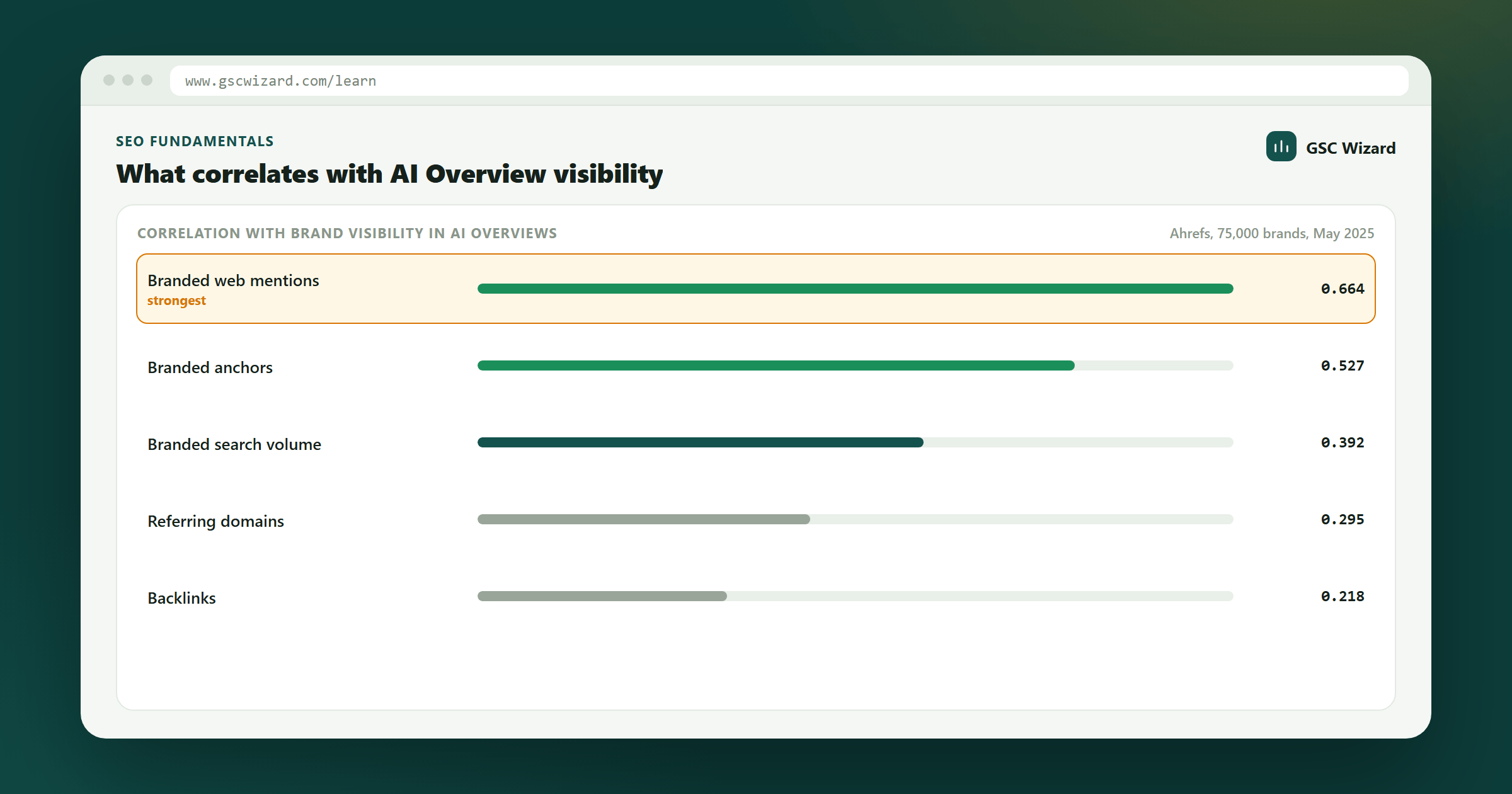
The largest study on this, Ahrefs' analysis of 75,000 brands in Google AI Overviews from May 2025, found that branded web mentions correlated at 0.664 with AI visibility, branded anchors at 0.527 and branded search volume at 0.392, while plain backlinks came in at only 0.218. Semrush found something that points in the same direction in October 2025, because nofollow links correlated with AI visibility just as strongly as followed links did, which only makes sense if the value is in being talked about rather than in passing PageRank.
Google confirms the mechanism and closes the obvious loophole in the same paragraph of its guide. Its AI features can show what people say about products across blogs, videos and forums, but chasing inauthentic mentions is on its list of GEO tactics you can ignore, because the same ranking and spam systems sit underneath. Paying for a spot in a "best tools" listicle is the 2026 version of the free product in exchange for a link, and it carries the same risk.
This is how I market GSC Wizard. I try to be visible everywhere, with the same informational content on Medium, Hashnode and Dev.to, each piece mentioning the product, plus Reddit, YouTube and paid, because the technical optimization and intent matching are things every competitor can copy, while user signals, branded searches and links come from marketing. Branded search is also where you see it break first: in September gscwizard.com briefly lost its own brand query in one European SERP while the AI overview still described the product correctly, which is why I now monitor branded queries per market.
What the data says, and where it disagrees
Every study below is correlational, most come from vendors who sell the metric they measured, and the numbers are not comparable across studies, so read them as direction rather than proof.
| Study | Published | Surface | Sample | Links | Brand and mentions |
|---|---|---|---|---|---|
| DerivateX | May 2026 | ChatGPT with search | 233 software recommendations, 40 categories | Domain authority ranked behind list format and freshness | G2 and Capterra cited zero times; every cited page was a list |
| SE Ranking via SEJ | Nov 2025 | ChatGPT | 129,000 domains | 350,000+ referring domains: 8.4 citations on average, versus 1.6 to 1.8 below 2,500 | Listed on Trustpilot, G2 or Capterra: 4.6 to 6.3 citations, versus 1.8 when absent |
| Semrush | Oct 2025 | ChatGPT, Gemini, AI Overviews, Perplexity | 1,000 domains | Authority Score vs. AI mentions 0.65; nofollow 0.340 vs. follow 0.334 | Not measured |
| Ahrefs | May 2025 | Google AI Overviews | 75,000 brands | Backlinks 0.218; referring domains 0.295 | Branded mentions 0.664; branded search 0.392 |
| Seer Interactive | Apr 2025 | LLM answers | 10,000 questions | Domain Rank 0.25, the strongest signal | Branded search volume 0.18 |
| Seer Interactive | Jan 2025 | Google, Bing, GPT-4o | 10,000 questions | Page-one Google rankings about 0.65; backlinks weak | Not measured |
The first disagreement is mentions versus authority. Ahrefs has branded mentions beating backlinks three to one, while Seer found Domain Rank to be the strongest signal and Semrush saw Authority Score track AI mentions closely, and my reading is that big brands simply score high on rankings, authority and mentions at the same time, so none of these studies can separate the three.
The second is review platforms. SE Ranking links a G2, Capterra or Trustpilot listing to roughly three times more ChatGPT citations, while DerivateX did not see a single G2 or Capterra citation in 233 software answers, and both can be true if a good profile mostly helps you get into the listicles that do get cited. I would still fix the profile, because the description on it is text that writers and models reuse, but I would not expect it to be the page that gets the citation.
What I would do in 2026
Keep the 2004 playbook, and change where you aim it and what you count as a win.
- Pick link targets by what the page says about you. A link from a page that explains your product in your category is worth more than a higher DR link from a page that only drops your name, because the second one gives a model nothing to read.
- Point part of your link budget at third-party pages. If an honest review, comparison or listicle already describes you well, helping it rank for the queries an AI fans out to does more for your AI visibility than another link to your own homepage.
- Get the review platforms in your category right. Use the same one-line description of what you do on your homepage, G2, Capterra and your other profiles, so every writer and model that reads them repeats the same thing.
- Count unlinked mentions and nofollow links as wins. The Ahrefs and Semrush data both suggest the value sits in being talked about, so a strong mention without a link is not a failed outreach.
- Do not buy listicle spots or reviews. Google treats it as link spam in Search and as inauthentic mentions in its AI features, and both run on the same spam systems.
- Measure brand, not just links. Track branded queries per market in Search Console and use its Generative AI performance report, because branded queries are where the GSC Wizard brand drop showed up first.
Sources
- Google Search Central, "Optimizing your website for generative AI features on Google Search", 10 July 2026, Google for Developers, developers.google.com/search/docs/fundamentals/ai-optimization-guide
- Google Search Central, "Spam policies for Google web search", accessed 7 October 2026, Google for Developers, developers.google.com/search/docs/essentials/spam-policies
- Aleyda Solis, "Learn Link Building", 8 September 2025, LearningSEO.io, learningseo.io/seo_roadmap/seo-fundamentals/link-building/
- Cyrus Shepard and Dawn Shepard, "Google Ranking Factors Expert Survey 2026", 9 September 2026, Zyppy Signal, signal.zyppy.com/p/google-ranking-factors-expert-survey
- Barry Schwartz, "Google Ranking Factors Survey: Content & Backlinks Most Important", 10 September 2026, Search Engine Roundtable, seroundtable.com/google-ranking-factors-expert-survey-42057.html
- DerivateX Research, "The B2B SaaS AI Citation Study: How ChatGPT Recommends Software", 31 May 2026, DerivateX, derivatex.agency/report/b2b-saas-ai-citation-study/
- Matt G. Southern, "New Data Reveals The Top 20 Factors Influencing ChatGPT Citations", 26 November 2025, Search Engine Journal, searchenginejournal.com/new-data-top-factors-influencing-chatgpt-citations/561954/
- Margarita Loktionova, "Do Backlinks Still Matter in AI Search? Insights from 1,000 Domains", 16 October 2025, Semrush, semrush.com/blog/backlinks-ai-search-study
- Louise Linehan and Xibeijia Guan, "An Analysis of AI Overview Brand Visibility Factors (75K Brands Studied)", 26 May 2025, Ahrefs, ahrefs.com/blog/ai-overview-brand-correlation/
- Nick Haigler, "Does Brand Awareness Impact LLM Visibility?", 16 April 2025, Seer Interactive, seerinteractive.com/insights/does-brand-awareness-impact-llm-visibility
- Christina Blake and Nick Haigler, "What Drives Brand Mentions in AI Answers?", 7 January 2025, Seer Interactive, seerinteractive.com/insights/what-drives-brand-mentions-in-ai-answers
Next up: Measure AI Overviews on your branded queries. Set up branded keywords and intent clusters in Search Console to see where your brand loses clicks.
Written by Jan-Willem Bobbink · Published October 7, 2026