Bing AI Performance report explained: Copilot citations, Topic Portfolio and opportunity queries
The AI Performance report in Bing Webmaster Tools shows how often your pages are cited as sources in Microsoft Copilot, in AI-generated summaries in Bing and in some partner AI experiences, for which grounding queries, and which URLs get the citations. It has two tabs: Citations & Pages, with your own citation counts, and Topic Portfolio, added in October 2026, which groups those queries into topics and lists the opportunity queries where other sites are cited and yours is not. Below are Microsoft's own definitions for every column, followed by my real Topic Portfolio for gscwizard.com and how I decided which of its fifty opportunity queries deserve a page.
Read the AI Performance report correctly and turn the opportunity list into a short list of pages worth writing or fixing.
About 30 minutes for the first triage, then a monthly check.
A site verified in Bing Webmaster Tools, ideally with enough AI citations for the Topic Portfolio tab to appear.
What is the AI Performance report in Bing Webmaster Tools?
Microsoft introduced AI Performance as a public preview in February 2026 as "a new set of insights that shows how publisher content appears across Microsoft Copilot, AI-generated summaries in Bing, and select partner integrations." It sits in the left-hand menu of Bing Webmaster Tools under the Search Performance report, and the top of the page names its scope in one line: "Citation sources: Microsoft Copilots and Partners." Microsoft does not name the partners in its announcements, so you cannot split the numbers by surface.
The report counts citations, which means the times one of your pages was shown as a source in an AI-generated answer. It does not count clicks, and it does not tell you where in the answer your link appeared. That makes it a different kind of number from anything in Search Performance, and it is the reason I read it next to referral data in Google Analytics rather than instead of it (more on that below).
The Citations & Pages tab
The first tab is the original report. Microsoft's February post defines its measures, and the wording matters because each one has a caveat built in:
| Measure | Microsoft's definition |
|---|---|
| Total Citations | "The total number of citations that are displayed as sources in AI-generated answers during the selected time frame," without indicating placement within an answer. |
| Average Cited Pages | "The average number of unique pages from your site that are displayed as sources in AI-generated answers per day over the selected time range." |
| Grounding queries | "The key phrases the AI used when retrieving content that was referenced in AI-generated answers." Microsoft adds that "the data shown represents a sample of overall citation activity." |
| Page-level citations | Citation counts per URL, which "reflects how often pages are cited, not page importance, ranking, or placement." |
| Citation Share | Added in June 2026: "the percentage of citations attributed to your site out of all citations shown across all sites for that same grounding query." |
A grounding query is not what the person typed. It is the search phrase the AI system ran to find sources for its answer, so one long prompt can produce several short grounding queries, and a grounding query often reads like a classic keyword. The June 2026 update added three more things to this tab: Intents, which label grounding queries as Informational, Commercial, Navigational, Learn and Solve, Research, Creation, Local and so on; Topics, which group related grounding queries; and Compare, which overlays a previous period, such as the prior 30 days or a custom range, on the current chart.
What is Topic Portfolio in Bing Webmaster Tools?
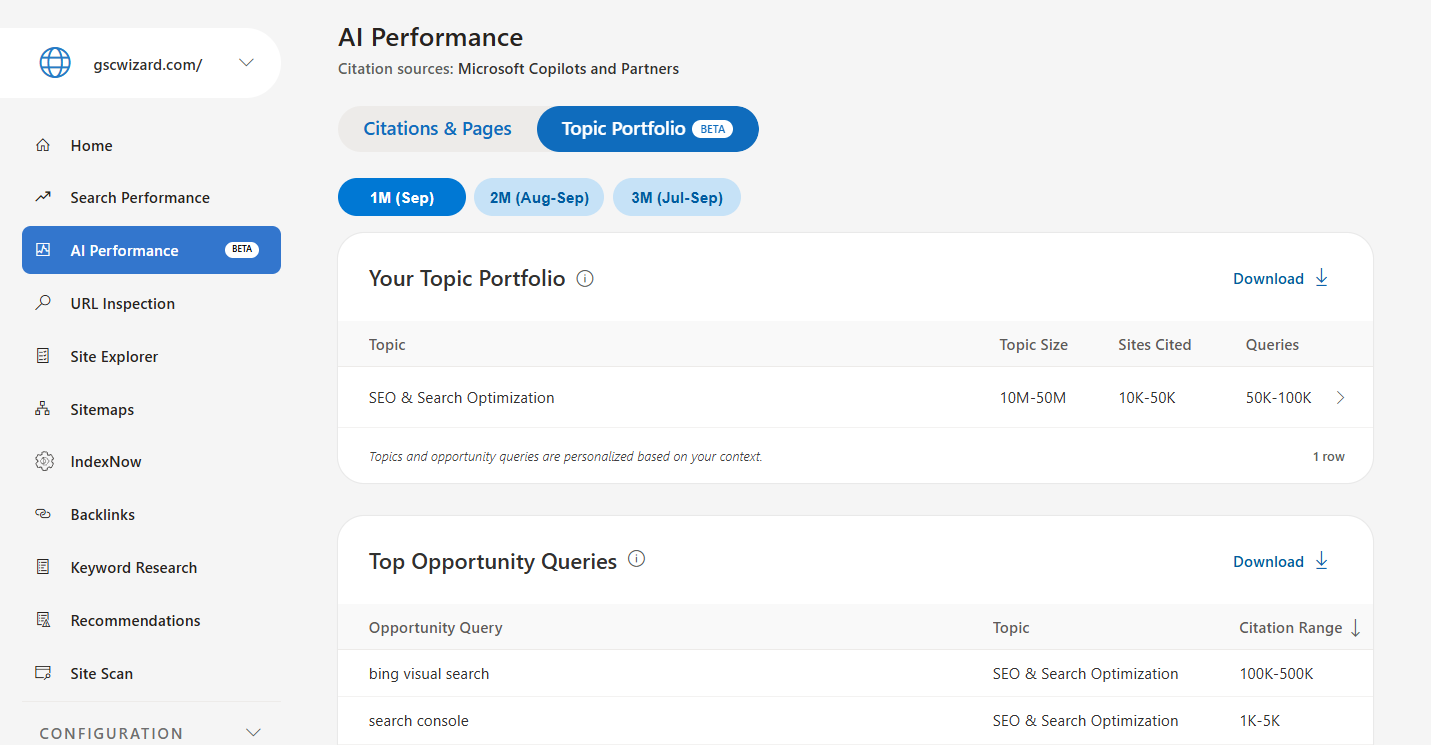
Topic Portfolio is the second tab, announced on October 13, 2026. Microsoft's post calls it "Topics Portfolio" while the tab itself reads "Topic Portfolio", and both names mean the same view. It "groups the grounding queries where your site appears into broader thematic clusters" and adds three ecosystem numbers to each cluster, so you can see how big and how crowded a topic is, not only how often you are cited in it. The tab only appears "if there is sufficient data for your site", and its period buttons offer one, two or three months: on my account in early November they read 1M (Sep), 2M (Aug-Sep) and 3M (Jul-Sep), so the newest complete month in the view was September.
The landing table is called Your Topic Portfolio. These are the definitions Bing shows behind the info icon next to the heading, which match the October post almost word for word:
| Column | Microsoft's definition | How I read it |
|---|---|---|
| Topic | "A broad thematic cluster of related grounding queries where your site appears." | The label is AI-generated, so it can be broader than you would choose. |
| Topic Size | "Approximate total citations across all sites for this topic over the selected period. A rough measure of how much AI Search demand this topic represents." | Demand for the whole topic on Microsoft's AI surfaces, not your share of it. |
| Sites Cited | "Approximate number of sites cited on queries in this topic. Indicates how crowded a topic is." | Competition. Many sites means citations are spread thin. |
| Queries | "Approximate number of distinct grounding queries in this topic." | How wide the topic is. A large number with a small Topic Size means a long tail. |
All three numbers are shown as ranges (10M-50M, 10K-50K), and Microsoft asks you to "treat the numbers as directional signals for planning, not as a precise ledger." Clicking a topic opens a detail page with three cards, Topic Size, Your Citations ("Number of times your site was cited in AI Search for queries in this topic over the selected period") and Queries, above two tables: Your Grounding Queries, where you already appear, and Opportunity Queries, where you do not. Every topic row and every opportunity query has a thumbs up and thumbs down control that sends feedback straight to the team that builds the classification.
Top Opportunity Queries and Citation Range
Below the topic table sits Top Opportunity Queries, with three columns: Opportunity Query, Topic and Citation Range. Bing's tooltip defines the list as "top grounding queries across topics relevant to your site where other sites are cited but yours is not," and the October post calls them "the strongest queries across your whole portfolio where other sites appear and yours does not," adding that "citation volumes there are shown as ranges rather than exact numbers."
That is all Microsoft says about Citation Range. It does not spell out whose citations the range counts, so here is my reading, which follows from the definition: an opportunity query is by definition one where your site was not cited, so the range is the number of citations that query produced for other sites in the selected period. It is a measure of how often the question gets answered with sources, the same idea as Topic Size at the level of a single query, and it says nothing about your own visibility. On my list, "bing visual search" showed 100K-500K while most queries showed 1K-5K or less.
What "personalized based on your context" means
The footnote under the topic table reads "Topics and opportunity queries are personalized based on your context." Microsoft explains it in the October post: "Everything in this view is personalized to your site. The topics and the opportunity queries are surfaced from your own presence and activity in AI Search, not from a generic ecosystem list." Microsoft does not say what else counts as context. My reading is that the topics are built from the grounding queries you are already cited for, and the opportunities are then picked from inside those topics, which is why a site with one strong topic gets one row, and why two competitors in the same niche see different lists.
Microsoft also lists the known limits of the view: topic classification "can occasionally be imperfect", topics with too little presence or activity are hidden ("smaller sites may see a shorter list or may not even see this feature"), and "branded queries can appear as opportunity queries", meaning a competitor's brand name can show up as your opportunity.
A worked example: my own Topic Portfolio for gscwizard.com
This is the Topic Portfolio for gscwizard.com for September 2026, the one-month window. Bing put the whole site into a single topic, which fits Microsoft's warning that smaller sites see shorter lists:
| Topic | Topic Size | Sites Cited | Queries |
|---|---|---|---|
| SEO & Search Optimization | 10M-50M | 10K-50K | 50K-100K |
Read with Microsoft's definitions, that says the SEO topic drew somewhere between 10 and 50 million citations on Microsoft's AI surfaces in one month, spread across 10,000 to 50,000 cited sites and 50,000 to 100,000 distinct grounding queries. It is a big and crowded topic, which is no surprise, and the size alone tells me nothing about where my site stands in it.
I downloaded the Top Opportunity Queries list, which held fifty queries, all in that same topic. The first thing I did was sort them by what the person asking actually wants, because a query only counts as an opportunity if a page from my site would be an honest answer to it:
| What the query asks for | Queries | Examples from my list | My call |
|---|---|---|---|
| An SEO agency, service or package | 38 | top ai-powered seo agencies; best agencies for aeo seo reporting; seo outsourcing agency; seo betreuung; four "seo agenturen deutschland österreich" variants | Skip, apart from one honest guide for people choosing an agency |
| Search Console or "webmaster tools" by name | 3 | search console; google search consle; webmaster tools | Fix existing pages |
| A free rank tracker or a Google ranking check | 2 | free rank tracker tool; keyword ranking google | Write a page |
| How to check a site for AI search | 1 | how to check if website is optimized for ai search | Write a page |
| A product category I do not make, or a Bing feature | 2 | keyword research tools; bing visual search | Skip |
| Too vague to answer, or generic terms in other languages | 4 | keyword strategy impact ai search visibility; zoekmachine optimalisatie; zoekwoorden; hvordan øke lokal synlighet på google | Skip |
So 38 of the 50 opportunities were requests for an agency or an SEO service, in English, German, Dutch and Spanish. GSC Wizard is a reporting tool that I build on my own, not an agency, and an AI answer to "top ai seo agencies" should cite agencies and reviews of agencies, not a software vendor. I could write a page stuffed with "AI SEO agency" phrases, and it might even get cited once or twice, but it would be a page that misleads the person asking, and it would sit badly next to everything else on the site. That is the main lesson of the list: Bing's opportunity selection knows which topic you are in, not what you sell, so most of the work is saying no.
The near-duplicate strings that look like prompt-tracker traffic
The second thing that stood out was how many queries were near-copies of each other, in a word order nobody types into a search box:
- best seo agencies ai-native aeo optimization blog experiment okr pages, best seo agencies ai-native aeo optimization blog okr pages, best seo agency ai-native aeo optimization blog okr pages, and best seo agency ai native aeo optimization blog okr pages
- top ai seo agencies ai-driven services, top ai seo agencies ai-driven seo services, top ai seo agencies ai-powered services, top ai seo agencies ai-powered seo services, and top ai seo agencies advanced ai-driven seo services
- best agencies for aeo seo reporting, best agency for aeo seo reporting, and best agencies aeo seo reporting
- best seo packages ai search video search, best seo packages ai search optimization video search optimization, and best seo packages ai search optimization video seo
Fifteen of the fifty are variants of four strings. Microsoft does not say where grounding queries come from beyond AI answers on its surfaces, so this is a reading rather than a fact, but strings like "blog okr pages" look like the output of templated prompts that a tracking tool, or an agency checking its own visibility, runs every day with small changes. If that is right, those queries measure how often someone tests the question, not how many real buyers ask it. I give clusters like these no weight, and I use the thumbs-down control on them so the feedback reaches Microsoft.
The top 20 opportunity queries and what I did with each
| Opportunity query | Citation Range | My call |
|---|---|---|
| bing visual search | 100K-500K | Skip: a Bing product question that Microsoft's own pages answer best |
| search console | 1K-5K | Fix an existing page: What is Google Search Console |
| top ai seo services for small businesses | 1K-5K | Skip (agency) |
| best seo packages ai search video search | 1K-5K | Skip (agency) |
| top ai seo agencies ai-driven services | 1K-5K | Skip (agency) |
| best seo packages ai search optimization video search optimization | 1K-5K | Skip (agency) |
| top ai-powered seo agencies | 1K-5K | Skip (agency) |
| best seo agencies ai-native aeo optimization blog experiment okr pages | 1K-5K | Skip (agency, templated) |
| top rated ai seo services for small businesses | 1K-5K | Skip (agency) |
| webmaster tools | 1K-5K | Fix existing pages and this one: see which "webmaster tools" |
| best agencies for aeo seo reporting | 1K-5K | Write one page for the buyer: how to choose an AI SEO agency |
| top seo agencies ai seo services | 1K-5K | Skip (agency) |
| best agency for aeo seo reporting | 1K-5K | Covered by the agency guide |
| best seo agencies ai-native aeo optimization blog okr pages | 500-1K | Skip (agency, templated) |
| best agencies aeo seo reporting | 500-1K | Covered by the agency guide |
| top ai seo agencies ai-driven seo services | 500-1K | Skip (agency, templated) |
| expert seo services google ai search engines | 500-1K | Skip (agency) |
| best seo agency ai-native aeo optimization blog okr pages | 500-1K | Skip (agency, templated) |
| top ai seo agencies ai-powered services | 500-1K | Skip (agency, templated) |
| google search consle | 500-1K | Nothing extra: same intent as "search console" |
From the rest of the list, "free rank tracker tool" and "keyword ranking google" became a page on free rank tracking with Search Console and Bing, and "how to check if website is optimized for ai search" became a page on checking whether your site shows up in AI search with your own data. That is four new pages, this one included, and two fixes out of fifty queries, which is roughly what I would expect from any list that is selected by topic rather than by fit.
The agency guide deserves a word, because it looks like it contradicts the rest. I did not write a page that claims to be an agency or ranks agencies. The buyer's real question behind "best agencies for aeo seo reporting" is how to tell a good agency from a bad one, and part of that answer is checking the agency's reports against your own Search Console, Bing and GA4 data, which is something I know well. If a query's honest answer would never cite a page like mine, I leave it alone.
How to decide which opportunity queries to act on
I run every opportunity query through three questions, in this order, and a query has to pass all three before it gets any writing time:
- Does it fit what you actually offer? Read the query as a request. If the honest answer is a kind of business you are not (an agency, a marketplace, a local shop), skip it, however large its Citation Range. Microsoft's own warning that branded queries can appear as opportunities belongs here too: a competitor's product name is not yours to answer.
- Would the answer cite a page like yours? Imagine the answer Copilot writes and the five sources under it. For "search console" those are Google's help pages and a few guides; for "free rank tracker tool" they are tool pages and comparisons. If your page type is not among them, a better page will not change that.
- Does a page already exist? Search your own site before writing. If a page covers the question but is not cited, fix that page: answer the question in its first paragraph, use the query's own words in a heading, put comparable facts in a table and add a short FAQ. Microsoft's February post gives the same advice, saying that "clear headings, tables, and FAQ sections help surface key information." Only write a new page when nothing on the site answers the question directly.
Then weigh what is left by Citation Range, with the near-duplicate clusters counted once. A 1K-5K query that passes all three questions is worth more than a 100K-500K query that fails the first.
How to check whether a new page gets cited
Publishing is half the job; the other half is confirming that Bing picked the page up and that it starts to appear as a source. This is the routine I follow:
- Submit the URL through IndexNow on the day you publish. Microsoft recommends this in the AI Performance announcement, because "IndexNow helps keep information fresh across search and AI experiences by notifying participating search engines whenever content is added, updated, or removed." You can submit in Bing Webmaster Tools, through your CMS, or from the IndexNow report in GSC Wizard, which keeps a per-URL history of the response codes. Keep the key file hosted: a 202 response only means the batch was received, and the engines drop it if they cannot verify the key.
- Confirm the page is indexed in Bing. URL Inspection in Bing Webmaster Tools tells you whether Bing has the page. A page that is not indexed cannot be cited.
- Watch the Pages list in Citations & Pages. Filter the date range to the weeks after publishing and look for the URL among your cited pages. Compare against the previous period to see whether citations are new or just moved between pages.
- Check the topic detail page a month later. Topic Portfolio works in whole months, so the effect only shows once the next month is in the view. The sign you are looking for is a query moving from the Opportunity Queries table into Your Grounding Queries for the same topic.
Do not expect every page to be cited, and do not read one month of silence as failure. Microsoft describes the grounding query data as a sample, and citation patterns shift with model changes and with what other sites publish.
How this relates to Search Console AI data and GA4 AI referrals
Three first-party sources tell you something about AI search, and each one measures a different moment. Bing's AI Performance report counts citations, Google's Search Console counts impressions and clicks, and Google Analytics 4 counts the visits that arrive:
| Source | AI surfaces covered | What it counts | What it cannot tell you |
|---|---|---|---|
| Bing AI Performance | Microsoft Copilot, AI summaries in Bing, unnamed partners | Citations per grounding query and per page; topics and opportunity queries | Clicks, placement in the answer, which surface |
| Google Search Console | AI Overviews and AI Mode, combined | Impressions in the Generative AI performance report, by page, country, device and date | Queries and clicks: the Performance report has no AI filter, and AI clicks count under Web |
| Google Analytics 4 | Assistants that pass a referrer, such as ChatGPT, Gemini, Copilot and Perplexity, but not AI Overviews or AI Mode | Sessions and conversions by landing page and source, with an AI Assistant default channel | Citations that nobody clicked |
On the Google side there are two places to look. The regular Performance report has no AI filter: Google's AI features documentation says sites appearing in AI Overviews and AI Mode are "reported on in the Performance report, within the 'Web' search type", so AI clicks are mixed into your Web totals. Next to it sits the Generative AI performance report, which Google rolled out to all websites on August 31, 2026. It shows impressions only, for AI Overviews and AI Mode together, grouped by page, country, device or date, with no queries and no clicks. That makes it closer to Bing's Pages view than to its grounding queries. In GA4, the AI Assistant default channel covers visits "from sources like ChatGPT, Gemini, Deepseek, Copilot, or Grok" and "excludes Google's AI Overviews and AI Mode", which arrive as organic search. The page on checking whether your site shows up in AI search walks through what you can get out of that, and the one on AI referral traffic in GA4 shows how to see ChatGPT, Perplexity, Gemini and Copilot visits by page. When a Bing citation and a rise in copilot.microsoft.com referrals to the same page line up, that is the strongest evidence you will get that a page is earning its place in AI answers.
Bing Webmaster Tools, Google Search Console and the "webmaster tools" name
"webmaster tools" was one of my opportunity queries, and it is ambiguous on purpose. Google called its product Google Webmaster Tools until 2015 and then renamed it Search Console (the history is in Google Webmaster Tools vs Search Console), while Microsoft still uses the name Bing Webmaster Tools. Today the AI Performance report is one of the clearest differences between the two: Bing reports AI citations per grounding query and per page, while Search Console reports AI Overviews and AI Mode impressions per page only, in its separate Generative AI performance report. The full side-by-side is in Bing Webmaster Tools vs Google Search Console.
What GSC Wizard does and does not do here
To be plain about it: GSC Wizard does not import the AI Performance report. There is no Topic Portfolio, citation count or grounding query anywhere in the app or in the MCP server, and there cannot be until Microsoft publishes an API for it. The Bing Webmaster API methods Microsoft documents cover queries, pages, crawl stats, crawl issues, keywords, links and URL submission, and none of them returns AI citations. For AI Performance, Bing Webmaster Tools itself is the place to look. The same goes for Google's Generative AI performance report, which GSC Wizard does not import either.
What GSC Wizard does have for Bing is the classic search data, read through the Bing Webmaster API with your own API key: a Bing Overview with clicks, impressions, CTR and position, Bing Queries and Bing Pages reports, and Crawl Issues, all next to your Search Console data. The Bing Webmaster MCP tools expose the same data, plus keyword stats, to Claude, ChatGPT and other assistants, and IndexNow submission works both in the app and over MCP. For AI referrals, the GA4 section has an LLM Traffic report that groups visits from Copilot, ChatGPT, Perplexity, Gemini and other assistants. None of that replaces the AI Performance report, but it covers the other two columns of the table above.
Frequently asked questions
What does Citation Range mean in Bing AI Performance?
Citation Range is the column in Top Opportunity Queries that shows how many citations a query produced in the selected period, as a band such as 1K-5K instead of an exact number. Microsoft says opportunity citation volumes are deliberately shown as ranges. An opportunity query is one where other sites are cited and yours is not, so the range counts citations that went to other sites, not to you.
Is Bing AI Performance data available in the API?
Not as of November 2026. The Bing Webmaster API methods Microsoft documents cover query, page, crawl, keyword, link and URL submission data, and none of them returns citations, grounding queries or topics. The only way to get AI Performance data out is the Download button on each table in Bing Webmaster Tools.
Why are my opportunity queries agency queries?
Microsoft picks opportunity queries from the topics your site is already cited in, and a topic such as SEO & Search Optimization holds tool queries and agency queries together. My reading is that agency prompts also rank high on citation volume because they are asked over and over, many of them in near-identical keyword-stuffed wording that looks like templated prompts from tracking tools. Microsoft notes that topic classification is AI-generated and can be imperfect, and you can mark an off-target query down with the thumbs control.
What does "personalized based on your context" mean in Topic Portfolio?
Microsoft says everything in Topic Portfolio is personalized to your site: the topics and opportunity queries are surfaced from your own presence and activity in AI Search, not from a generic list. In practice the topics are built from the grounding queries your site is already cited for, so two sites in the same niche see different lists.
Why don't I see the Topic Portfolio tab in Bing Webmaster Tools?
Microsoft only shows the tab when there is sufficient data for your site. Topics with too little site presence or ecosystem activity are hidden, so a smaller site may see a short list or no Topic Portfolio tab at all, even though the Citations & Pages tab works.
Does the AI Performance report show clicks from Copilot?
No. It reports citations: how often your pages are shown as sources in AI answers, which pages, and for which grounding queries. For visits that came from Copilot, look at referrals from copilot.microsoft.com in Google Analytics 4.
Can GSC Wizard import the Bing AI Performance report?
No. GSC Wizard reads Bing Webmaster Tools query, page, crawl and keyword data through the Bing Webmaster API and can submit URLs through IndexNow, but it does not import AI Performance citations or Topic Portfolio, because Microsoft offers no API for them.
Next playbook
Bing's report shows citations; the next step is to see what Google shows you about the same pages. Check if your site shows up in AI search →
Bing and Google search data in one place
Bing Webmaster queries, pages and crawl issues next to Search Console and GA4, with IndexNow built in. 7-day free trial on every paid plan.
Written by Jan-Willem Bobbink · Published November 4, 2026 · Updated November 4, 2026