Notion
The same alerts, as rows in a Notion database. A traffic drop or a deindexed page becomes a page with its severity, alert type, property, date and a link to the report, and the numbers in the page body.
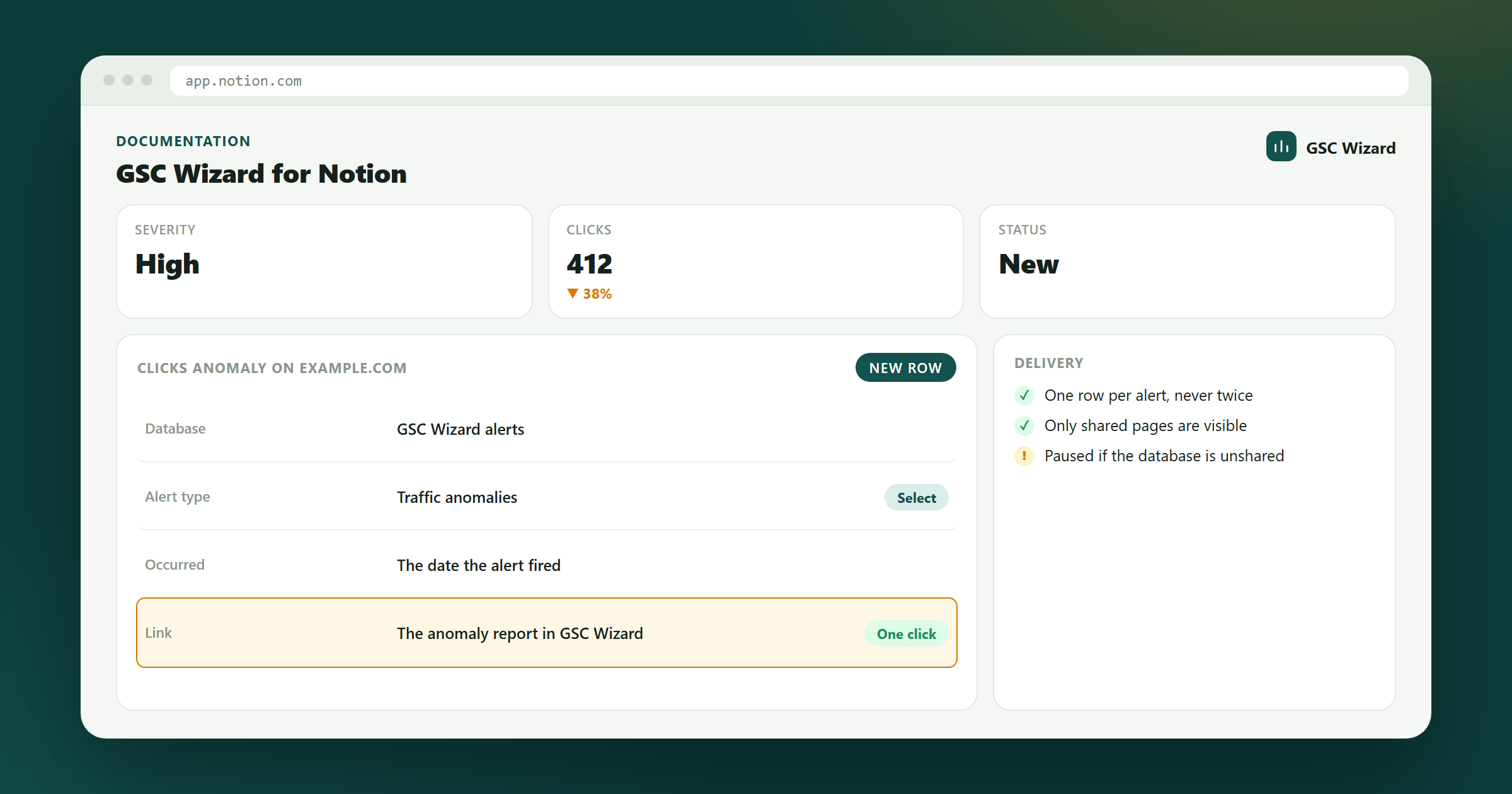
A Notion database subscribes to alert events exactly the way a Slack or Teams channel does, and receives each one as a new row. GSC Wizard creates the alerts database for you, or writes into one of your own. It only reads what you share with it and only adds: it never edits, archives or deletes anything in Notion. Set it up under Account → Slack, Teams & Webhooks; Slack is not needed. It needs a 7-day free trial or a paid plan.
Connecting Notion
- Open Account → Slack, Teams & Webhooks and click Connect Notion in the Notion section.
- Notion asks which workspace to connect and which pages GSC Wizard may use. Pick the page the alerts database should live under (for example your SEO team page), or an existing database alerts should go into, and approve.
- You land back on the settings page with the form open. To share more pages later, open the page in Notion, choose ••• then Connections, add GSC Wizard, and reload the list in the form.
Sending alerts to a database
Two choices, side by side in the form.
- Create a GSC Wizard alerts database: pick a shared page and GSC Wizard adds a database under it with the columns below. This is the quickest way, and every detail of an alert gets its own column.
- Use one of my databases: pick a shared database. GSC Wizard reads its columns and fills only those whose name and type match (see below); everything else goes into the page body. Your columns are never added to, renamed or changed.
- Tick the alert types and choose a minimum severity, the same choices an alerts subscription offers. Each matching alert becomes one row.
- Save, then click the send icon on the new destination: it adds a test row to the database, so you know it works before the first real alert. Delete that row afterwards.
To split properties or alert types across databases, add one destination per database, each with its own types and severity.
What a row contains
The same content an alert posts to Slack, written as a Notion page.
- Name (the title): the alert’s headline, for example Clicks anomaly on example.com for 14 Nov 2026.
- Severity (select): Critical, High, Medium, Low or Info.
- Alert type (select or text): the alert type as the setup page names it, such as Traffic anomalies.
- Property (text or select): the Search Console property, for example example.com.
- Occurred (date): when the alert fired. Link (URL): the report the alert came from, filtered to the property.
- Status (select): New, so the database works as a triage list. In a database of your own, a Status column of Notion’s status type is used only when it has a New option.
- Alert ID (text): a short reference a retried delivery uses to recognise its own row. Hide the column if you like; do not edit it.
- The page body holds the numbers behind the alert (actual against expected, the change, the affected URL), a note on how to read them, such as the roughly three-day Search Console lag, and links to the report.
In your own database a column is filled when its name matches (case does not matter) and its type fits; Date, URL and Site are accepted for Occurred, Link and Property. A select column only gets values it already offers, because adding an option would change your database: a value it lacks goes into the body instead.
Delivery behaviour
- Rows are created on the same job as Slack, which runs every ten minutes, so a row appears within minutes of detection.
- An alert becomes one row per database, never two. Notion has no way to set a page’s id in advance, so GSC Wizard records each alert before it creates the row; if the answer to a create is lost, the retry looks the row up (by its Alert ID, or by its title among the rows GSC Wizard created) before it creates anything.
- Notion outages and rate limits are retried on later runs.
- A destination is paused, with the reason on it, when Notion stops accepting the connection or the database was deleted, moved to the trash or is no longer shared with GSC Wizard. Destinations can be paused and resumed at any time. Deleting one stops new rows at once; rows already created stay in Notion.
- If you rename or retype a column, the next alert reads the columns again and fills what still matches.
Permissions and data
GSC Wizard asks Notion for two capabilities only.
- Read content: to list the pages and databases you shared, read a database’s columns, and look up a row it created itself when a delivery is retried.
- Insert content: to create the alerts database under the page you picked, and to create rows.
- It does not ask for Update content, comments or user information, so it cannot edit, archive or delete anything, and it never sees names or email addresses.
- It sees only the pages and databases you share with it, and the pages under a shared page.
- The access and refresh tokens are encrypted at rest (AES-256-GCM). Nothing from Notion is stored beyond the workspace id, name and icon, the ids, titles and links of the databases you route alerts to, which of their columns are filled, and the id and link of each row an alert created (kept 30 days).
- The row carries the alert’s content into your workspace: the property, and depending on the alert, page URLs, search queries and metric values. Everyone who can see the database can read it.
See the privacy policy for how GSC Wizard handles data.
Disconnecting
- Disconnect next to the workspace revokes the token at Notion and deletes it here, together with every destination on that connection.
- You can also remove GSC Wizard in Notion under Settings → Connections. Notion does not tell apps about that, so GSC Wizard notices on the next alert and pauses the destinations until you reconnect.
Troubleshooting
The page or database is missing from the form
It is not shared with GSC Wizard. In Notion, open it, choose ••• then Connections, add GSC Wizard, and click the reload button next to the list.
“Reconnect this Notion workspace first”
Notion no longer accepts the connection, usually because it was removed in Notion. Click Reconnect; destinations paused for this reason resume on their own.
“Paused: the database was deleted or is no longer shared”
Restore the database from the trash or share it again, then resume the destination, or delete it and add a current database.
A column stays empty
Its name or type does not match, or it is a select without the option GSC Wizard would write. The value is in the page body; add the option or rename the column to match.
Still stuck? Email info@gscwizard.com.